If you've ever stared at a tender pack on a Friday afternoon and thought, “We could win this, if only we had time to do it properly,” you're not alone. Most SMEs don't lose because they lack capability. They lose because they chase the wrong opportunities, answer too loosely, or run out of time before the evidence is in place.
What Tender Competitions Actually Look Like for SMEs
A lot of small firms approach public procurement as if a good company should naturally win a good contract. It doesn't work like that. A strong offer still goes nowhere if the bid misses the buyer's scoring model, the evidence is thin, or the opportunity was never a fit in the first place.
That is the starting point for winning the tender in the UK. Large corporations won approximately 90% of contracts considered suitable for SMEs, leaving smaller suppliers potentially excluded from around £30 billion of public-contract value each year, and only 1 in 5 UK SMEs had bid for a public-sector contract during the preceding three years. Among SMEs with between 1 and 9 bids, 49% had failed to win a single contract over that period (Hansard debate on public procurement).
For a bid team, that changes the job. You are not trying to be “good enough” in the abstract. You are deciding which tenders deserve effort, how each answer should line up with the buyer's criteria, and where the actual delivery risk sits before you spend days writing.
A weak fit is expensive. It burns time, pulls staff away from billable work, and can strain cash flow if the tender requires heavy mobilisation, long payment terms, or proof of capacity you do not yet have.
Practical rule: if a tender does not fit your capability, evidence, and cash position, it is a distraction.
That is why process matters as much as prose. A PDF toolkit for government teams helps public teams handle documents cleanly, and suppliers need the same level of control on their side. If you want a more systematic starting point, Bidwell for SME owners is built around the same reality, finding suitable tenders, keeping evidence ready, and reducing the chaos around submission.
Why the New Procurement Regime Changes the Game
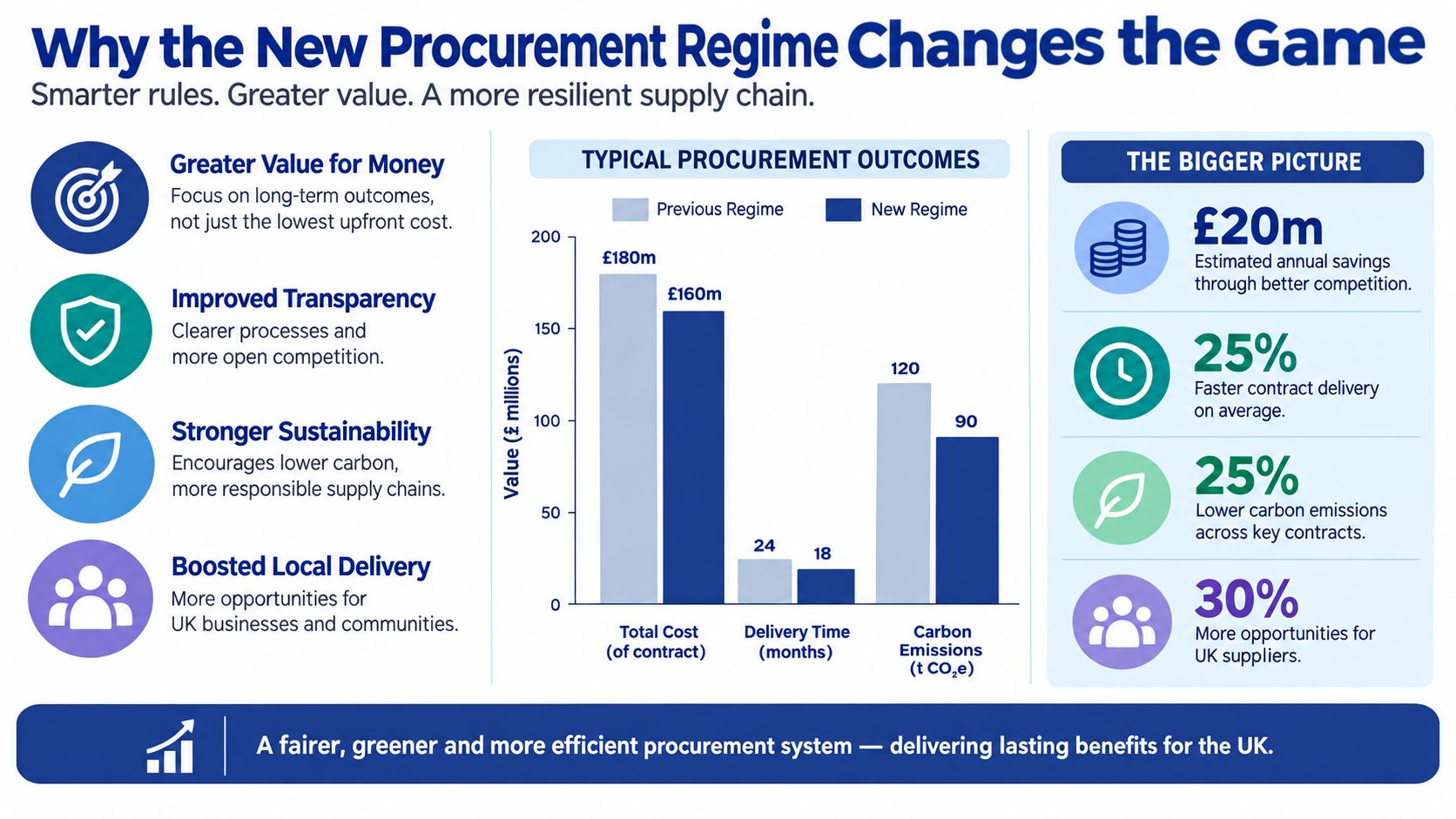
The new procurement regime shifts where opportunities appear and how they are won. More of the market now sits in open competition, which helps SMEs that can respond well. It also exposes weak generic bids and overreliance on familiar contacts.
The first year of the regime shows that shift clearly. Analysts at Open Contracting found that open tenders rose from 27% in March 2025 to 41% in February 2026, while direct procedures fell from 53% to 34%, single-bid lots dropped from about 21% to around 16%, and SME and VCSE bids grew from 54% to 67% (Open Contracting data on the UK Procurement Act). The same analysis also shows that more tenders are being contested, not handled as near-private deals.
What that means in practice
Smaller suppliers are appearing in greater numbers, and the pool they are competing in is wider. That makes the quality of the response matter more, not less. Buyers still reward clarity, evidence, and fit with the scoring model.
The same analysis found that at least one SME won an award in 61% of open tenders. That is encouraging, but it does not make open competition easy. It means the route to victory is clearer if you can find the right notices quickly, read the scoring properly, and answer to the standard the buyer is using.
Cash flow still decides a lot of bids. A stronger market for SMEs does not remove the risk of long payment terms, heavy mobilisation, or work you cannot fund upfront. The firms that win most often are the ones that choose tenders carefully, protect margin, and bid only where the evidence already exists.
Screening Tenders Before You Bid
A lot of bids are lost before anyone writes a response. A team spots a tender, gets interested, and only later finds the catch. The buyer needs insurance they do not hold, coverage outside their area, or pricing that only works if margin is squeezed too far. That is a screening failure.
Start with hard stops
Reject any opportunity where you cannot meet the mandatory conditions. Check accreditations, geography, capacity, insurance thresholds, financial tests, and contract terms that create exposure you cannot carry. If a pass/fail item is already out of reach, do not turn it into a hopeful stretch.
Then test the fit. Can you answer the highest-weight criteria with real evidence? Do you have case studies that match the buyer's priorities? Will your price sit in the right range for the service model they want? If the answer is no on two or three of those points, the bid usually is not worth the time.
Bid/no-bid rule: only spend serious writing time when you can point to evidence for each high-weight criterion, not just enthusiasm for the work.
The Department for Education reported that SMEs received 53% of its contracts in 2025-26, representing 20 of 38 contracts and approximately £28.5 million, and the same guidance stresses that evaluators score what is written against published criteria, not what they assume (Department for Education evidence). That matters because it shows SMEs can win when the fit is right, but only if the response is written to the scoring model.
A simple decision matrix helps keep the process disciplined.
| Criterion | Pass | Fail |
|---|---|---|
| Mandatory compliance | You can meet every mandatory requirement | Any pass/fail gap remains |
| Delivery fit | You can cover the geography, volume, and timing | Capacity or coverage is stretched |
| Evidence strength | You have proof for the highest-weight criteria | Claims would rely on generic language |
| Commercial fit | Price and margins still make sense | The work only fits if you take a dangerous margin hit |
Cash flow still decides a lot of bids. A better market for SMEs does not remove the risk of long payment terms, heavy mobilisation, or work you cannot fund upfront. The firms that win most often are the ones that choose tenders carefully, protect margin, and bid only where the evidence already exists.
For teams that want a repeatable way to screen opportunities and gather proof in one place, Bidwell's tender workflow puts those steps side by side.
Engineering Responses from Evaluation Criteria
A bid can look polished and still lose if it answers the wrong thing. Buyers do not score brochure language. They score how tightly your response tracks the published criteria and the evidence behind each point.
Build from the scoring model backwards
Under the Procurement Act 2023, award criteria must relate to the contract and be clear, measurable, specific, and proportionate (UK Government guidance). That gives you the structure. Pull out every award criterion, sub-criterion, weighting, pass or fail condition, and required attachment, then turn each one into a response matrix with four columns, requirement, method, measurable outcome, and proof.
That is the difference between a tidy response and a competitive one. Generic capability statements waste space. A response built from the scoring model speaks in the evaluator's language. If the question asks for delivery approach, set out the operating process. If it asks for value, show the service level or outcome. If it asks for risk, name the control, the owner, and the contingency.
Useful habit: write the answer in the same order the evaluator will score it, not in the order that feels easiest to your team.
The same guidance warns that evaluators assess only the published criteria and the information in the tender, so unsupported assumptions and evidence placed in the wrong section create avoidable score loss. If your strongest proof sits under the wrong heading, it may as well not exist.
Use a claim evidence impact pattern
A stronger response usually follows a simple pattern. State what you will do. Explain how you will do it. Then show what proof supports it. That matters because you are not just drafting text. You are matching each requirement to the right evidence and trimming it to fit the limit.
- Claim: what will happen.
- Evidence: the case study, policy, accreditation, or process that supports it.
- Impact: the buyer outcome, such as reduced risk, better continuity, or clearer accountability.
Before submission, run a red-team review against every criterion. Check that each mandatory attachment is present, every declaration is complete, and the price-quality calculation has been tested against the buyer's formula. If the scoring model can be gamed by an odd pricing pattern, it will be, so scenario-test it with dummy bids as the guidance recommends.
Bid writers using Bidwell's bid-writing software can keep this requirement-to-proof structure inside a reusable knowledge base. That helps when the same organisation is bidding across several lots with different scoring weights.
When Winning Could Be a Problem
Winning feels good until the contract starts pulling cash out of the business before the buyer's first payment lands. A tender should be judged on score, mobilisation strain, working capital pressure, and whether the contract fits the way your business operates.
Check the scale before you chase the score
A 2025 survey found that 42% of public-sector respondents cited SMEs' ability to scale service delivery as a barrier, and 64% cited bid or competition capability (YPO survey report). That matters because it shows buyers are still worried about execution, not just paperwork. If they are worried, you should be too.

Public-sector contracts and supply chains are subject to 30-day payment terms, and government reporting for 2025 indicated that 99% of invoices were paid within 30 days. That is positive, but it does not remove the need to fund recruitment, equipment, onboarding, and delivery before invoices are settled. A contract can be profitable on paper and still hurt the business in month one.
A practical cash-flow test helps here. Ask whether you can fund mobilisation without stress, whether you need subcontractors to cover scale, whether the insurance and liability profile is acceptable, and whether the variation rules leave room to recover if scope changes. If the answer depends on “it'll probably be fine,” walk away or reshape the bid.
The best tender is not always the biggest one. It is the one that fits your balance sheet, your staffing reality, and your ability to deliver without heroic improvisation.
Building a Tender Monitoring System
If you're still relying on inbox luck, you're probably missing bids. The market is too fragmented for casual monitoring now, and the notice regime changes mean you need coverage across the right portals, not just one favourite site.
Put the pipeline in one place
For procurements beginning on or after 24 February 2025, the notice types required by the Procurement Act 2023 generally apply on Find a Tender, and suppliers need coverage across several UK portals while recognising which notice sequence applies to each opportunity (Find a Tender notice types). That means your monitoring process has to cover the main notice ecosystems, not just one stream.
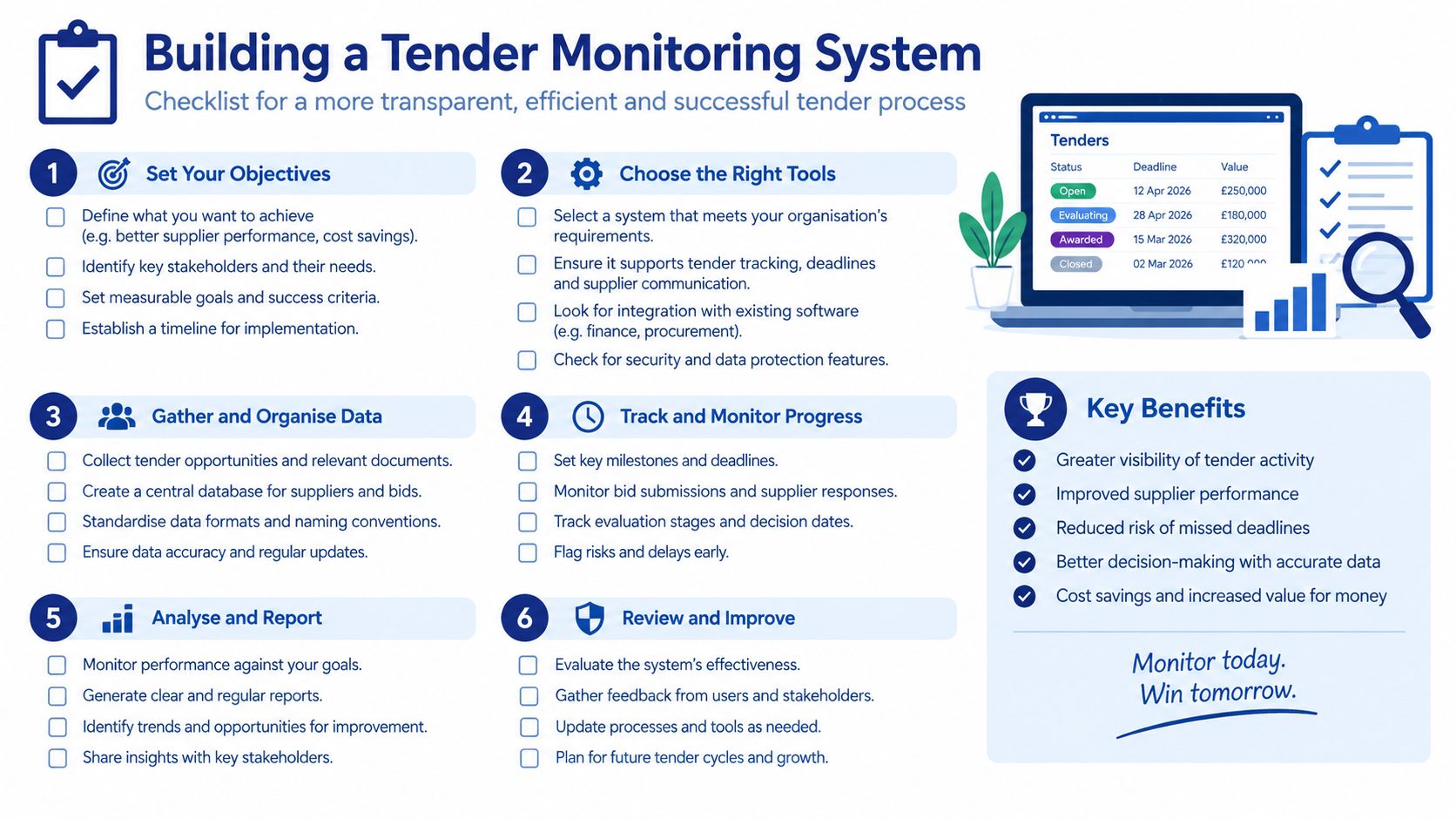
A workable system has three parts. First, tender monitoring across the major portals so you catch the notice early. Second, a knowledge base where you store case studies, credentials, policies, and team biographies. Third, AI response generation that turns that material into a draft aligned to the scoring model instead of another generic company profile.
That structure matters because it changes the work from starting from zero to editing from a strong base. It also helps you respond faster when a notice drops with a short window and several mandatory attachments. If your evidence is already organised, the whole process stops feeling like a firefight.
Bidwell fits that workflow cleanly. Its monitoring surfaces relevant opportunities, its knowledge base keeps the proof ready, and its AI response generation turns that material into first drafts ready for review. For teams trying to make tendering repeatable rather than chaotic, that combination is the difference between chasing notices and controlling the process.
If you want a cleaner way to spot suitable tenders, organise your evidence, and turn strong answers around faster, visit Bidwell and see how the monitoring, knowledge base, and AI response workflow fits your bidding process. It's a practical place to start if you're serious about winning more public sector work without burning the team out.