You've heard there's serious money in public sector work. Then a £200,000 opportunity lands in front of you, and the practical questions arrive quickly. Is it worth the bid effort? Where did the notice appear? Can your team meet the requirements, and will the buyer choose an incumbent before you get a fair hearing?
Those are sensible questions. UK government tenders aren't won by writing quickly after an ITT appears. They're won by treating procurement as a system, from early market signals through to award intelligence and future positioning. By the end of this guide, you'll know where to look, how thresholds and portals affect your workload, and how to build a bid process that doesn't consume weeks unnecessarily.
Why UK Government Tenders Matter Right Now
A tender lands on your desk, the contract value looks strong, and the deadline is tight. The mistake is treating that notice as the start of the sales process. In public procurement, the suppliers with a real chance are usually active earlier, before the formal ITT exists, when buyers are testing routes, shaping lots and signalling future demand.
The market is large enough to justify that effort. Between January 2020 and July 2023, UK public bodies awarded 18,314 managed service provider contracts worth £22.9 billion. Central government accounted for £15.103 billion, or 66%, NHS organisations for £3.131 billion, or 14%, and local government for £1.988 billion, or 9%, according to the UK government's managed service provider research.
Use that fact properly. It does not mean every supplier should chase Whitehall work. It means demand is spread across buyer groups, contract types and routes to market. For many SMEs, the better entry point is a local authority requirement, an NHS need, a place on a framework, or a specialist lot where the evidence burden matches the team you have on hand.
Commercial test: Ask whether the buyer, contract size, geography, evidence requirement and route fit your operating model.
That question matters more than enthusiasm. Buyers want proof that you can mobilise, govern delivery, manage risk, price sensibly and stay stable when the contract gets difficult. A polished website will not rescue a weak evidence base. Case studies, policies, financial credibility and reusable answers will.
If you are still deciding whether this channel deserves focus, back your business growth plan and make the decision commercially, not emotionally.
The suppliers that win repeatedly are disciplined early. They monitor pipeline and pre-market signals, not just live tenders. They keep proof organised before a deadline appears. They qualify hard and walk away from poor-fit notices. That is why government tenders matter now. They reward preparation across the full lifecycle, not fast reaction at the end.
What a UK Government Tender Actually Is
Think of a government tender as a formal job advert where the employer has to publish the brief, accept responses under defined rules and explain how it selected the successful supplier. The buyer isn't just comparing attractive proposals. It's running a regulated process with published requirements, evaluation criteria, deadlines and records.
A tender usually contains four things you need to understand immediately:
- The buyer and legal regime. Identify the contracting authority and when the procurement started. The Procurement Act 2023 governs procurements starting on or after 24 February 2025, while earlier procurements continue under the legislation that applied when they began. For many older public contracts, that means the Public Contracts Regulations 2015.
- The requirement. Read the specification, outcome requirements, service levels, social-value questions and contract terms. The opportunity title is rarely enough to judge fit.
- The route. The buyer may use an open competition, a competitive flexible procedure, a framework call-off or, in limited circumstances, a direct award. A framework opportunity may be commercially relevant even when you're not bidding for the immediate contract, because framework access can determine whether you can compete later.
- The evidence burden. The selection questionnaire, method statements, pricing schedules, accreditations and financial checks reveal what the buyer considers risky.
The 2026 international procurement thresholds are important planning markers. From 1 January 2026, supplies and services procured by central government authorities are subject to the international procurement regime at £135,018 including VAT, compared with £207,720 for sub-central authorities. Works contracts have a threshold of £5,193,000, as set out in the official 2026 threshold notice.
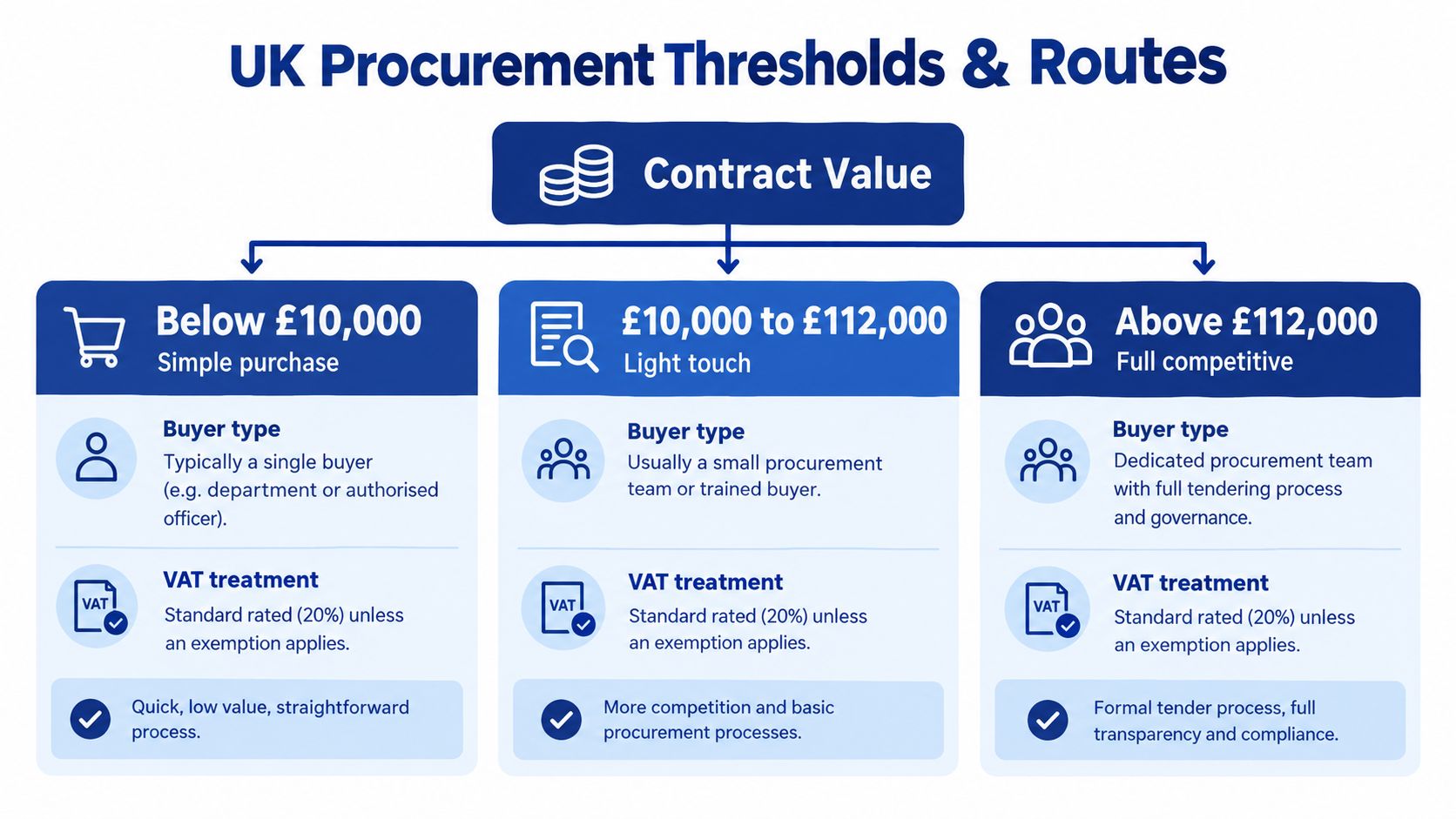
Don't assume a higher-value notice is automatically worth pursuing. The route changes the notice regime and timetable, but the bid decision still depends on contract fit, competition, mobilisation risk and your evidence.
Thresholds, Buyers and Procurement Routes
Thresholds work as a decision tree, not as a list to memorise. Start with the buyer. A central government authority is treated differently from a council, NHS body or other sub-central authority. Then classify the contract as supplies, services or works, establish whether the stated value includes VAT, and check whether the procurement contains mixed elements.
The 2026 figures create a practical distinction. A supplies or services procurement may enter the international regime at £135,018 including VAT for central government and £207,720 for sub-central authorities. Works sit at £5,193,000. Those thresholds don't tell you whether you'll win, but they tell you which notice and procedure expectations deserve attention.
Below-threshold work still matters. Opportunities over £12,000 including VAT, or over £30,000 outside central government, are directed to the relevant service for England and other non-devolved territories, Scotland, Wales or Northern Ireland. The Contracts Finder collection on data.gov.uk explains how these publishing arrangements operate across the services.
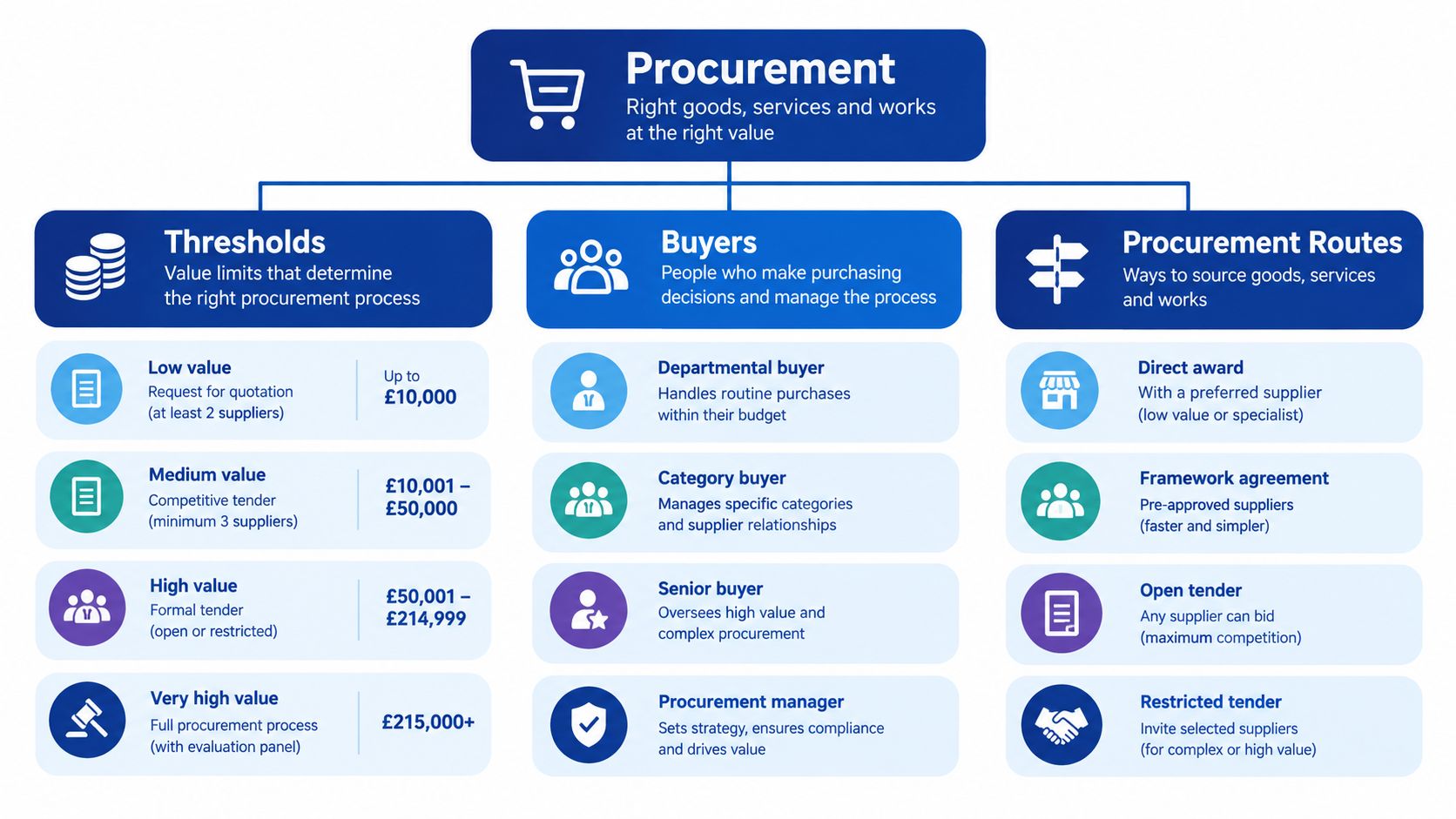
Use this classification checklist before you spend time reading the full pack:
- Buyer: Is it central government, a sub-central authority, an NHS organisation, a devolved administration or another public body?
- Contract type: Is the main requirement a service, supply, works contract or mixed procurement?
- VAT: Does the published value include VAT, and are extensions or options included in the total estimate?
- Route: Is it an open competition, competitive flexible procedure, framework call-off, light-touch route or direct award?
- Publishing service: Which portal should carry the notice, and could a second portal contain related information?
A portal record can look straightforward while the procurement documents reveal a demanding route. For example, a contract may be divided into lots but require accreditations, insurance, financial information and mobilisation resources that make one lot unsuitable for a small team.
If your process depends on several users, controlled documents and structured approval, secure procurement technology can help you assess the wider systems question. For opportunities connected with central government commercial agreements, also review the Crown Commercial Service buyer information before assuming an open-market bid is your only route.
Where UK Tenders Actually Get Published
“Check Contracts Finder” is incomplete advice. UK tender discovery is a coverage problem because the correct portal depends on geography, buyer, value and procurement start date.
For new UK procurements since 24 February 2025, Find a Tender publishes above-threshold and below-threshold notices, except below-threshold Scottish notices. Contracts Finder remains important for England and other non-devolved territories. Scotland, Wales and Northern Ireland each have their own principal services, and defence opportunities may sit on MOD Defence Contracts Online.
Government guidance confirms that Find a Tender works alongside Contracts Finder and the devolved and defence portals, and that the established advertising requirements remain in place.
| Portal | Coverage | Value range | Best for |
|---|---|---|---|
| Find a Tender | New UK procurements, except below-threshold Scottish notices | Above and below international thresholds, where applicable | Lifecycle notices and wider UK discovery |
| Contracts Finder | England and other non-devolved territories | Lower-value and relevant public sector opportunities | English public sector work and award intelligence |
| Public Contracts Scotland | Scottish public sector | Scottish opportunities, including below-threshold notices | Scottish authorities and devolved procurement |
| Sell2Wales | Welsh public sector | Welsh opportunities | Welsh authorities and local suppliers |
| eTendersNI | Northern Ireland | Northern Irish public sector | Northern Ireland procurement |
| MOD Defence Contracts Online | Defence-specific work | Defence opportunities | Suppliers with suitable security and delivery capability |
Don't search each portal manually and call that a monitoring process. Save searches by sector, CPV category, region, contract value and procurement stage. Remove duplicate notices, then rank what remains by deadline, buyer fit, geography, lot structure and likely accessibility.
Bidwell's tender monitoring brings major UK sources into daily alerts with summaries. Its value is not finding more notices. It helps a bid team separate an early signal from an urgent formal competition, so the response is based on the procurement stage rather than just a keyword match.
Search by capability and buyer problem, not only by the service name you use internally.
The Tender Lifecycle From Pipeline to Award
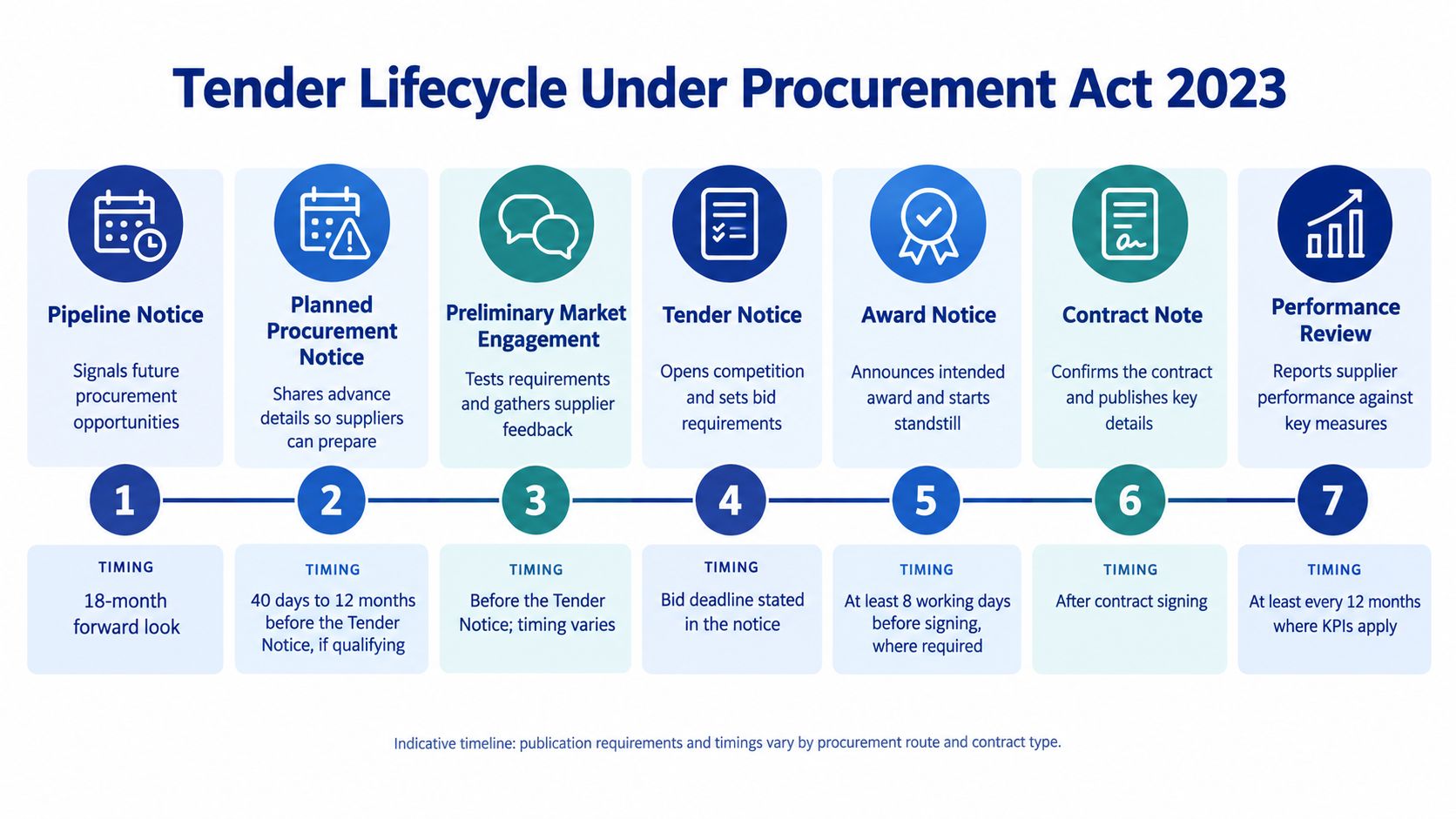
The formal ITT is often too late to begin thinking. The Procurement Act notice structure gives suppliers earlier signals, but only if each notice prompts a different action.
Read the notice as a commercial signal
A pipeline notice suggests that a buyer expects a procurement and gives you time to assess capability, partners and likely evidence. A planned procurement notice sharpens that signal. Start mapping your service to the probable requirement and identify gaps before the specification hardens.
A preliminary market engagement notice is an invitation to participate before the formal tender. Use it properly. Ask focused questions about outcomes, lotting, transition, data, contract length and barriers that could exclude capable SMEs. Don't use the session as a product pitch.
The tender notice is the formal competition. At that point, qualify the opportunity against the published requirements, download every document, build a compliance matrix and decide whether you can produce credible evidence within the timetable.
Treat award information as usable intelligence
An award notice tells you who won and starts the normal standstill period. A UK authority must normally allow at least eight working days between publishing the contract award notice and entering into the contract, under section 51 of the Procurement Act 2023. The clock begins on the day the award notice is published, as explained in the government guidance on competitive tendering procedures.
A contract detail notice records the resulting agreement. A contract termination notice can reveal when a relationship ended and may signal future market activity, although it doesn't automatically mean a replacement tender is imminent.
Bidwell's tender monitoring can flag notice-stage changes, while its knowledge base stores your previous answers, feedback and evidence against the relevant buyer or service. If you need to submit supporting files quickly, use a reliable method to compress files without losing quality, then check that the final documents remain readable and compliant.
What Actually Determines Whether an SME Wins
An SME usually loses long before the ITT deadline. It loses when it chases a notice that looked accessible on paper but was never commercially bidable for that business.
The Procurement Act 2023 improves the formal position. Buyers are expected to consider SME participation and whether a procurement should be split into lots. Treat that as an opening, not a guarantee. Suppliers that win separate policy intent from delivery reality, then decide early whether they can carry the contract on its actual terms.
That matters because a tender can be SME-friendly in name and still shut smaller firms out in practice. The barrier is rarely one headline rule. It is the combined effect of insurance levels, accreditations, turnover expectations, social value evidence, implementation timescales and the buyer's appetite for operational risk. Read the documents as a delivery test, not a marketing message.
Test bidability, not just eligibility
Start with the lot design. Check whether the lots are fully separable, whether the geography works, whether your case studies fit the scope, and whether the pricing model leaves enough margin to absorb service risk. A small supplier can meet the selection criteria and still have no credible route to delivery.
Use clarification questions properly. Buyers do change wording when a requirement is unclear, inconsistent or disproportionate. Do not send a complaint dressed up as a question. State the barrier, explain the delivery impact, and suggest an alternative that still protects the authority.
Consortium and subcontracting routes deserve more attention than they usually get. If your strength is a defined specialist work package, bid that reality. Do not force a prime position when the insurance, coverage model or mobilisation burden points the other way.
Bidability beats eligibility: You can technically qualify for a competition and still lack a credible route to delivery.
The advantage for SMEs comes earlier in the lifecycle. Prior information, pipeline visibility and pre-market engagement give you a chance to influence the shape of the requirement before the formal ITT exists. That is where smaller firms win ground. The best contributions are specific, operational and honest. Identify a buyer risk, show how you would manage it, and avoid promising a delivery model you cannot sustain.
How Long Bid Writing Really Takes and How to Cut It
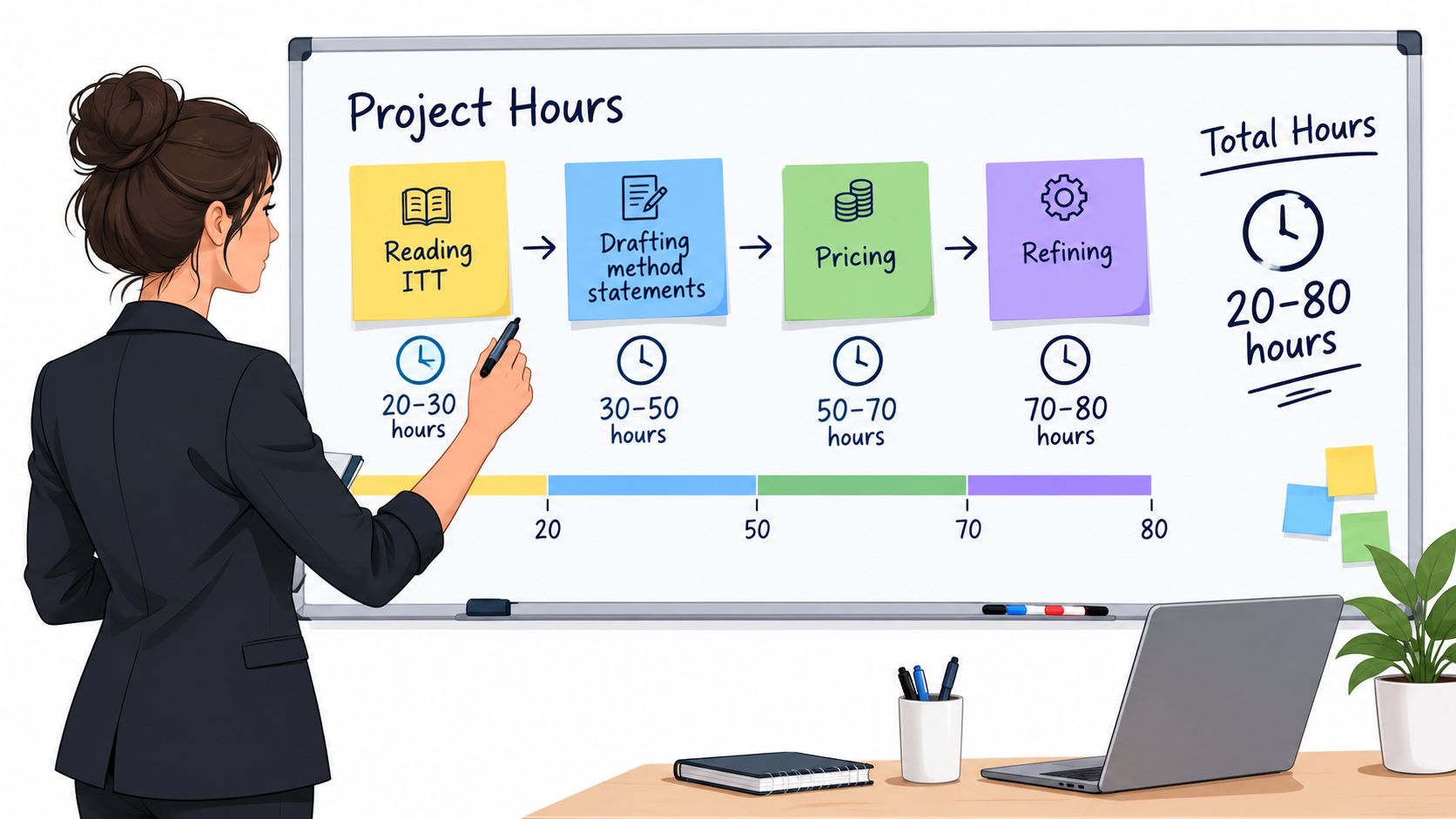
A serious tender response can consume 20 to 80 hours, depending on the complexity of the requirement, evidence burden, pricing model and approval process. The time usually goes into reading the ITT, building a compliance matrix, drafting method statements, collecting proof, completing pricing and reviewing the final submission.
The deadline can be shorter than your internal process. Under the competitive flexible procedure, the minimum tender period is 25 days when electronic tenders are permitted and the notice and associated documents are supplied together. It rises to 30 days when the notice and tender documents aren't all provided at the same time, according to the official Procurement Act e-learning guidance.
Budget the work before you commit
Use a simple workload split:
- Read and qualify: Understand the evaluation model, instructions, contract terms, risks and evidence gaps.
- Plan the answer: Convert each question into a response outline linked to the scoring criteria.
- Draft and evidence: Write the method, add relevant examples, assign owners and test every claim.
- Review and submit: Complete pricing, check word counts, run compliance checks and leave time for upload problems.
The competitive flexible procedure can allow a shorter period in qualifying circumstances, including a 10-day period where the relevant conditions apply. That makes early monitoring valuable. A short deadline is manageable only if you already know where your evidence sits and who can approve the answer.
Bidwell combines tender monitoring, a structured knowledge base for credentials and previous responses, and AI response generation that drafts against stored material. Its bid writing software is most useful when a human bid lead controls the evidence, edits for buyer relevance and checks every factual statement.
AI should produce a controlled first draft, not an unsupervised submission. It can reuse approved material and reduce repetitive writing, but your team remains responsible for accuracy, confidentiality, compliance and the quality of the evidence.
Putting It All Together
A workable weekly routine is simple enough to repeat:
- Monitor the portals: Check Find a Tender, Contracts Finder, Public Contracts Scotland, Sell2Wales and, where relevant, eTendersNI and MOD Defence Contracts Online.
- Rank the signals: Prioritise by procurement stage, deadline, contract value, geography, buyer fit and lot accessibility.
- Act early: Respond to market engagement and planned notices when you can add useful detail.
- Maintain evidence: Keep credentials, policies, case studies, pricing assumptions and previous feedback in a searchable knowledge base.
- Draft selectively: Use AI response generation for a controlled first pass, then review every answer against the evaluation criteria.
- Study awards: Record winners, contract values, lots and buyer patterns to improve future qualification.
Contracts Finder published 60,584 award notices in financial year 2023/24, creating a substantial historical record of buyers, winners and contract decisions. Government monitoring also recorded 11,743 eligible opportunity notices between July 2020 and April 2021, with an average coverage rate of 85.1%, as reported in the Public Procurement Review Service progress report.
That data is useful, but only if you organise it. Award notices can show which suppliers already hold relationships with a buyer, what contract shapes recur and where a partnership route may be sensible. The standstill period can also give an unsuccessful supplier a defined opportunity to review feedback and consider its next step.
The practical model is clear. Monitoring finds the opportunity and identifies its lifecycle stage. The knowledge base preserves the evidence your business has already earned. AI response generation helps turn that evidence into a focused draft when the timetable is tight. Bidwell brings those functions together for suppliers that want a repeatable tender workflow, rather than a new scramble every time a notice appears.
Bidwell monitors major UK tender portals, sends daily opportunity summaries, and keeps your credentials and previous responses organised in a working knowledge base. Visit Bidwell to find relevant tenders earlier and turn bid-ready evidence into focused response drafts before the deadline becomes a crisis.