It's 4pm on a Tuesday. You've checked Find a Tender, Contracts Finder and a devolved portal, but you're still unsure whether the notices match your services, whether an amendment changed the deadline, or whether you've missed something published elsewhere. That isn't a tender strategy. It's a daily guessing exercise.
A reliable tender search UK process must do more than collect live notices. It needs to follow the procurement lifecycle, from an early pipeline signal to a published competition, then through amendments, clarifications, awards and future recompetes. The practical answer combines coverage, qualification and response preparation, with Bidwell's tender monitoring, knowledge base and AI response generation supporting the workflow.
Why Manual Tender Hunting Fails
Manual tender hunting usually starts with good intentions. A bid manager opens several portals in the morning, saves a few searches, checks email alerts and promises to review the results later. By late afternoon, urgent client work has taken over, and the team can't confidently say whether every relevant notice was seen.
The problem isn't a shortage of public-sector work. In 2023, the wider UK public sector spent £194.8 billion on third-party goods and services, while direct procurement spending with SMEs reached £39.7 billion, according to the British Chambers of Commerce and Tussell SME Procurement Tracker. SMEs received only 20% of total direct public procurement spending, despite the increase in absolute spend.

The hidden cost of checking portals
Fragmentation creates more than inconvenience. Each portal has different filters, notice types, terminology and publication habits. A pipeline notice may sit on one service, while the later invitation to tender appears on another record. An amendment can change the timetable without looking like a completely new opportunity.
Manual searches also encourage broad keyword habits. A supplier searches for “software”, “consultancy” or “construction”, then spends time opening irrelevant notices. Narrow the search too aggressively, and the team may exclude a suitable opportunity described using a buyer's preferred terminology.
Practical rule: Treat every search as a coverage system, not a recurring browsing task. Record the portals, saved filters, notice types and owners so someone else can verify what's being monitored.
The shift from chasing to receiving
A useful tender search should send relevant opportunities to the team, with enough context to make an initial decision. That means matching by capability, buyer, geography, contract value and procurement stage, then presenting a short explanation of why the notice matters.
Bidwell's tender monitoring is designed for that first control point. It monitors relevant UK procurement sources and provides daily alerts with summaries, so the team can review a prioritised pipeline instead of refreshing pages. The monitoring layer doesn't replace judgement. It gives bid managers a more dependable starting point for it.
Navigating the Main UK Tender Portals
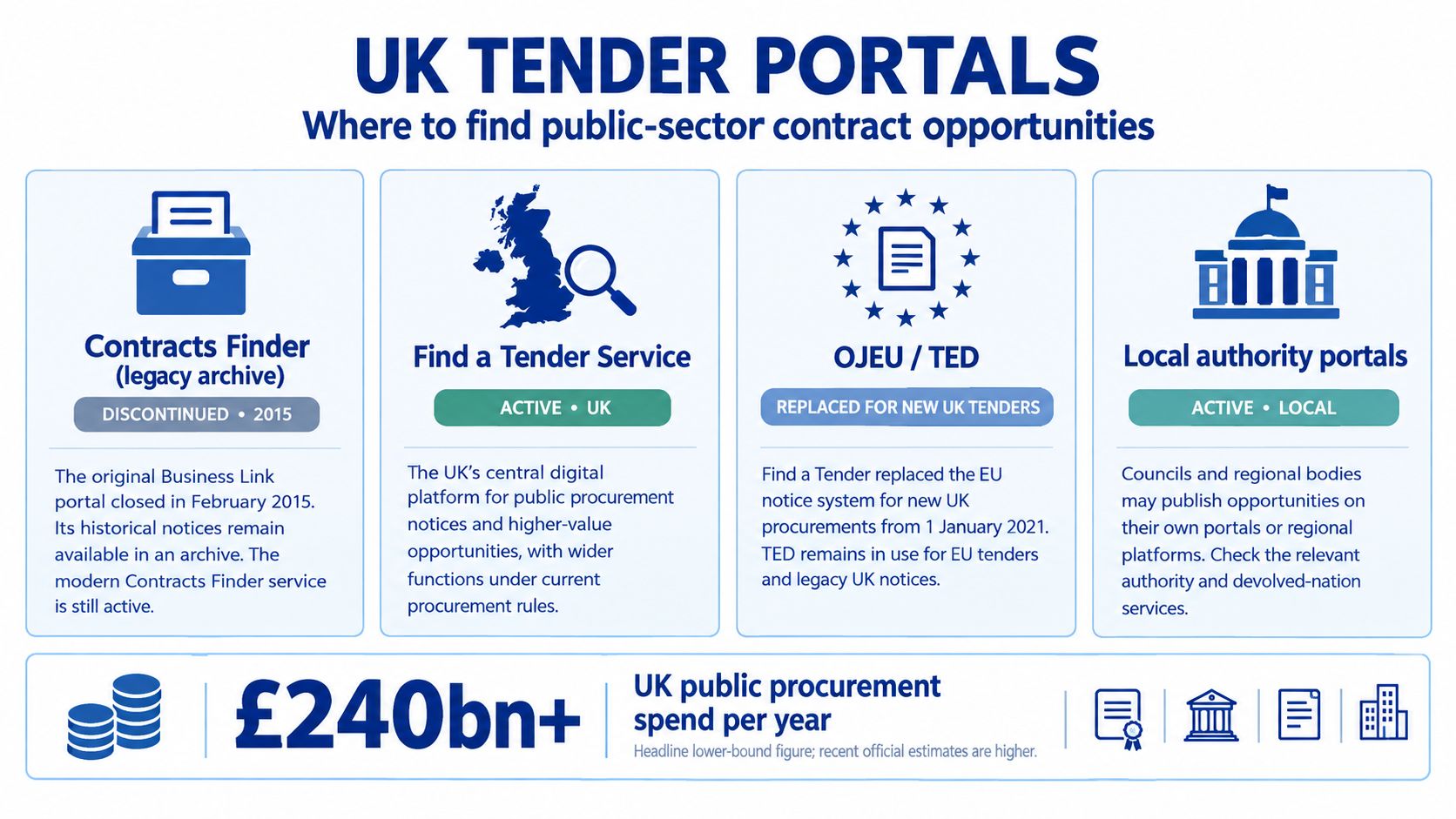
Start with the source that matches the procurement route, then add the portals needed for geographic coverage. Find a Tender is central to UK public procurement notices under the current system, while Contracts Finder remains important for opportunities and awarded contracts from central government, local authorities and other public bodies. Scotland, Wales and Northern Ireland also have their own services, including Public Contracts Scotland, Sell2Wales and eTendersNI.
Use each portal for a defined purpose
Find a Tender should be part of the core watch for above-threshold opportunities and notices published under the current regime. Search by CPV code first, then refine by buyer, region, procurement stage and contract value. Keep pipeline, tender and award searches separate. They answer different commercial questions.
Contracts Finder supports searches by keyword, location, procurement stage, date range, contract value and industry classification. It also allows records to be downloaded in XML or CSV formats. That makes it useful not only for discovery, but also for reviewing buyer activity and historic awards.
Public Contracts Scotland, Sell2Wales and eTendersNI need their own monitoring where your delivery footprint includes those nations. A national search can't safely be treated as a complete substitute for checking devolved services.
Contracts Finder recorded 34,968 awarded contracts in the 2025/26 financial year, a 36.1% increase compared with 2024/25. SMEs accounted for 12,533 awards, with SME awards rising by 41.7% year on year, as reported in the Contracts Finder collection on data.gov.uk.
Follow the notice lifecycle
A UK1 pipeline notice is an early warning for a planned contract valued at £2 million or more that a buyer expects to award within the next 18 months, according to government guidance on Procurement Act notices. It isn't an invitation to bid. The later UK4 tender notice is the point at which suppliers can normally submit bids.
That distinction matters operationally. A pipeline signal gives you time to confirm capacity, find delivery partners, refresh case studies and decide whether the buyer's likely requirement fits your strategy. A team monitoring only live competitions may discover the opportunity when the response clock has already started.
Bidwell brings the separate sources into a tender monitoring workflow, with daily summaries and relevant matches. The benefit is not fewer browser tabs. It's the ability to see an opportunity as a developing record rather than an isolated notice.
Building a Qualification Workflow
Finding a tender is only the first decision. Before anyone starts drafting, extract the conditions that can disqualify the bid and the criteria that will decide the score.
Build a requirements matrix containing:
- Mandatory conditions: Capture eligibility, accreditations, insurance, financial requirements and geographic constraints.
- Scored questions: Record each question, weighting, response format and evidence expectation.
- Delivery obligations: Note mobilisation, staffing, service levels, reporting and social value requirements.
- Submission controls: Record the clarification deadline, word limits, file formats and final submission timestamp.
Then apply a bid/no-bid gate. Score strategic fit, relevant capability evidence, delivery capacity, incumbent position, contract economics and compliance risk. If the business can't evidence a mandatory requirement, the answer is normally no, regardless of how attractive the contract looks.
Choose the right competition
Procurement route is a useful qualification signal. Open Contracting analysis found that SMEs won at least one contract in 61% of open tenders and 73% of below-threshold open competitions, but only 36% of direct awards, as set out in UK government guidance on Contracts Finder transparency. These are procurement-level proportions, not an individual supplier's win probability.
Use that evidence to shape attention, not to promise an outcome. Openly competed smaller lots with clear SME suitability may deserve priority, while frameworks and larger opportunities may require a consortium, subcontracting or call-off strategy.
Your knowledge base should hold the evidence needed to make this decision quickly. Store current case studies, policies, accreditations, CVs, references, mobilisation plans and approved answers. If a team needs help connecting these checks to wider business processes, workflow automation services can provide useful context on designing repeatable approval and handover flows.
A structured bid writing software workflow can then connect the qualification decision to the response plan. The important point is ownership. Every requirement needs a named person, an evidence source and a status.
Automating the Search Process
Manual searching and automated monitoring solve different problems. Manual review gives you control over every result, but it consumes time and depends on someone remembering to check each source. Monitoring gives you coverage and consistency, but poor filters can produce noise that nobody trusts.
The workable model is selective automation followed by human qualification.
Manual searching versus controlled monitoring
| Manual approach | Monitored approach |
|---|---|
| Team members revisit multiple portals | Saved criteria are checked across relevant sources |
| Results are reviewed in inconsistent batches | Alerts arrive in a shared bid workflow |
| Pipeline and live notices can be confused | Notice stage is visible during triage |
| Evidence is searched across old folders | Reusable material sits in a knowledge base |
| Writers start from blank documents | AI response generation uses approved source material |
Bidwell's three features fit together here. Tender monitoring surfaces relevant notices. The knowledge base stores credentials, previous responses and case studies. AI response generation uses that material to prepare a custom draft against the tender requirements, leaving the bid team to review, improve and approve the content.
The response window can be tighter than a new team member expects. Under the Procurement Act 2023, the standard minimum tendering period is 25 days when bids are submitted electronically, and it can fall to 10 days in specific cases, including urgent procurement, according to the government guidance on time periods.
Reduce blank-page work, not review quality
AI shouldn't invent evidence, make unsupported promises or decide that a weak fit is worth pursuing. Give it approved source material, the exact evaluation criteria and clear instructions about what it must not claim.
A practical workflow looks like this:
- Monitor: Receive a relevant notice and classify its stage, buyer, route and deadline.
- Qualify: Apply the bid/no-bid gate before committing writers and subject-matter experts.
- Prepare: Pull current evidence from the knowledge base and identify gaps.
- Generate: Use AI response generation for a structured first draft aligned to each criterion.
- Review: Run a human red-team check for compliance, accuracy, word counts, pricing assumptions and portal requirements.
Teams considering wider process design can compare this with a proven task automation approach, particularly where repetitive checks, approvals and handovers are creating avoidable delays. The principle is straightforward. Automate repeatable administration, but keep accountable people responsible for evidence and final submission.
Practical guidance, templates and supporting material are available in Bidwell's tender guides. Use them to standardise the workflow before increasing the number of searches or bids.
Turning Insights into Wins
A tender search becomes commercially useful only when the information reaches the right person early enough to act. The daily routine should be simple: review alerts, classify each notice, update the opportunity record and make a clear decision.
Start with the monitoring record. Capture the buyer, procurement stage, CPV code, deadline, lot structure, framework status and source notice. If the item is a pipeline notice, assign a future review date rather than treating it as a live bid.
Next, maintain the knowledge base as an operational asset. Retire expired policies, label case studies by service and buyer type, and record the evidence owner for each reusable answer. A case study without a current contact, outcome or delivery detail may look complete but won't support a strong response under pressure.
Make response generation accountable
When an opportunity passes qualification, map every question to evidence before drafting. The response should follow a clear chain:
Requirement → method → evidence → outcome → risk control
AI response generation can prepare the first version using the approved knowledge base, but a subject-matter expert must check whether the method is deliverable and whether the evidence answers the question. A bid manager should then test traceability against the specification and evaluation criteria.
Quality check: A fast draft is useful only when the team can explain where every important claim came from and how it meets the buyer's requirement.
Keep the final control separate from writing. Check word counts, attachments, pricing assumptions, clarification responses and portal uploads independently. Bidwell's tender use cases show how monitoring, stored evidence and response generation can sit in one workflow, but the bid team still owns the final decision and submission.
Common Myths About Tender Searching
Myth one: centralisation means one portal is enough. Find a Tender improves visibility, but UK procurement still involves Contracts Finder and devolved services such as Public Contracts Scotland and Sell2Wales. Publication practices and notice histories differ, so cross-portal monitoring remains necessary.
Myth two: an SME-friendly label means an easy win. Open Contracting analysis of Find a Tender data found that SMEs represented 54% of bidders in March 2025, rising to 67% in February 2026, while only 6.4% of below-threshold open competitions were formally reserved for SMEs or VCSEs, according to the government's procurement announcement.
Myth three: contract value is the best qualification signal. A modest contract with an open competition, suitable lot and credible evidence may be more realistic than a larger direct award or framework opportunity. Read the route, competition structure, mandatory conditions and delivery risk before judging the headline value.
The strongest tender search UK process is therefore selective rather than exhaustive. Monitor broadly enough to protect coverage, interpret each notice's lifecycle, then qualify ruthlessly before writing.
Bidwell brings UK tender monitoring, a reusable knowledge base and AI response generation into one workflow, helping teams move from fragmented portal checks to prepared, evidence-led bids. Visit Bidwell to see how it can support your tender search and response process.