On Tuesday morning, the bid manager at a 40-person facilities management firm in Manchester is already carrying two live submissions and a PQQ. Then the managing director forwards an email about a £1.2 million NHS cleaning contract in Leeds. The deadline passed yesterday. Nobody in the team saw it in time.
That failure rarely comes from laziness. Someone searched Contracts Finder with the wrong phrase. The CPV code wasn't included. The opportunity sat on a council or NHS sub-portal. A colleague received a Found.UK alert but forgot to forward it. The result is more serious than a missed line in the pipeline. The buyer may remember that your firm didn't engage, and the next conversation starts with less credibility.
A tender alert service can prevent this, but only when it fits the full bidding workflow. Monitoring is the first job. You also need sensible filtering, a disciplined go or no-go process, a reliable knowledge base, AI-assisted drafting and human review. The practical question isn't whether alerts exist. It's whether the right opportunity reaches the right person early enough to act.
The Morning You Almost Missed a Perfect Tender
By half past nine, the bid manager has opened three spreadsheets, searched two portals and checked a shared inbox. The NHS cleaning contract would have fitted the company's geography, service line and operational capacity. Instead, the managing director found it through a contact who happened to mention it after the closing date.
The firm already had access to the obvious sources. Contracts Finder was bookmarked. Someone monitored Find a Tender. ProActis appeared in the team's notes. None of that created complete coverage because each source described and published opportunities differently.
Why a good fit can remain invisible
The search used “commercial cleaning”, while the notice used facilities management terminology. The team's saved search covered a narrow set of phrases but not the relevant CPV code. A colleague's Found.UK alert arrived in a personal inbox and never reached the bid manager. The listing may also have been published through a buyer-specific route that didn't appear cleanly in the team's usual morning routine.
This is the practical weakness of treating alerts as simple keyword matching. A supplier can have several portal accounts and still miss a notice because the source, metadata, timing and internal hand-off all failed at once.
Practical rule: A tender alert is useful only when someone can review it, decide on it and start the response before the deadline creates pressure.
The commercial damage is obvious, but the relationship damage is easier to overlook. If an NHS buyer, council or framework manager expects capable local suppliers to engage, repeated absence can affect how your business is perceived, even when the procurement remains formally open to competition.
Fix the workflow, not just the search
The answer isn't to ask one person to check more websites. That approach creates fragile dependency on memory and adds review work to an already crowded day. A better setup collects official and sector-specific notices, normalises the information, applies several matching rules and sends a short list with enough context for a decision.
The team still needs to open the original notice, check eligibility, assess capacity and decide whether to bid. The alert service removes avoidable discovery work. Bidwell's tender monitoring and response workflow is designed around that connection, linking opportunity discovery with a knowledge base and AI response generation rather than leaving the notice stranded in an inbox.
What a Tender Alert Service Actually Does
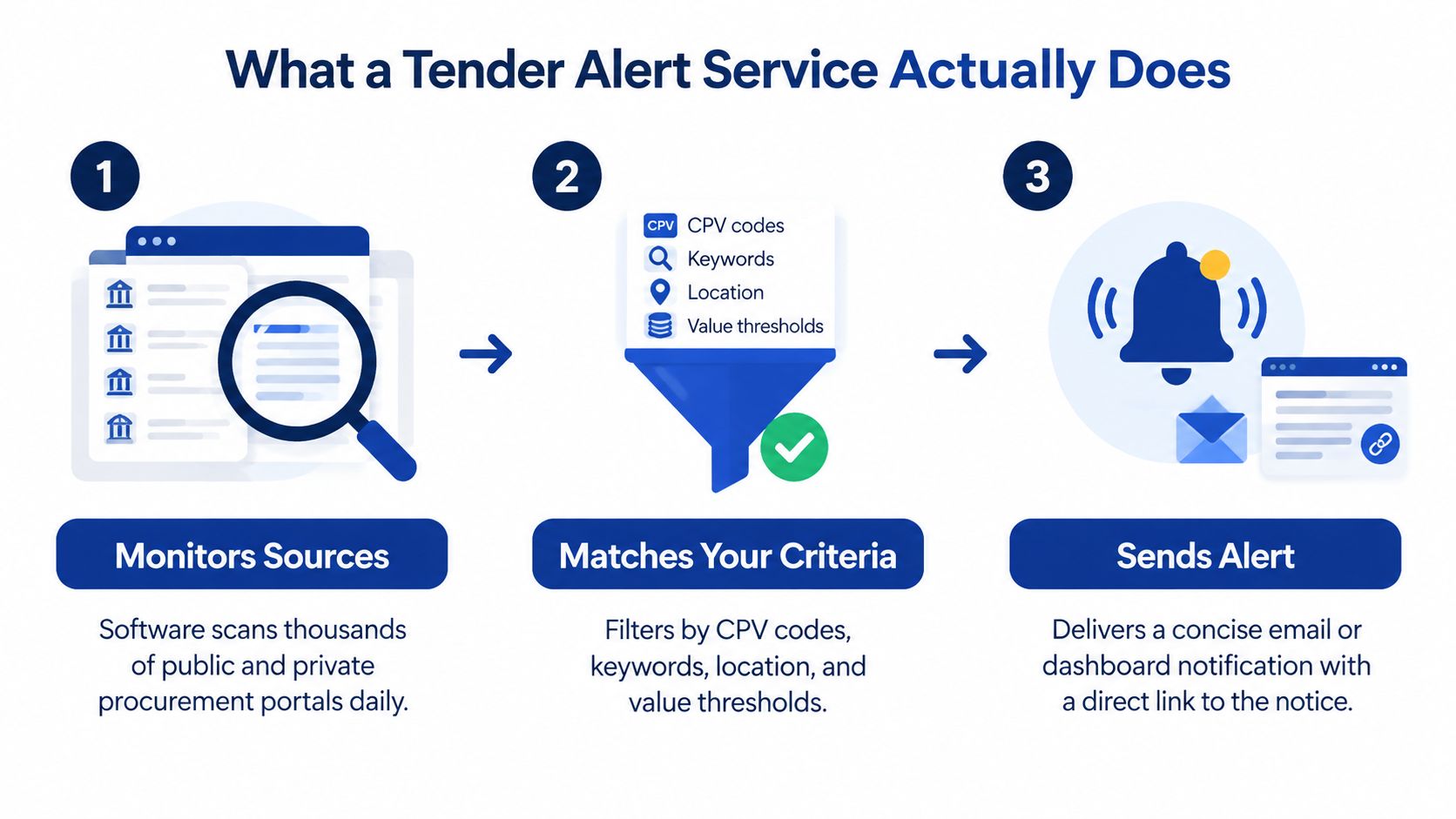
A tender alert service watches procurement sources for you, identifies notices that fit your organisation and sends them somewhere your team can act. That might be an email digest, a dashboard notification, a Teams channel or a record in a customer relationship management system.
The software performs three distinct jobs. Confusing them leads to poor expectations and disappointing results.
1. Watching the sources
The service collects notices from official procurement portals, sector systems, feeds and publisher integrations. In the UK, that means coping with different formats, publication schedules, notice types and fields across national and devolved systems.
A central platform can use structured government notice data. Find a Tender supports saved searches and email alerts, so suppliers can define criteria and receive notifications when matching notices are posted, as described in the government guidance for using the enhanced Find a Tender service.
2. Filtering the raw feed
A useful service combines CPV codes, keywords, exclusions, buyer names, geography and value ranges. It should also distinguish between notice types, such as pipeline notices, prior information notices, contract notices and awards.
That matters because a supplier isn't only looking for a live bid. Contracts Finder lets users search current opportunities, future opportunities and historic tender records, according to the official Contracts Finder service. Future and historic information can support pipeline planning, incumbent research and renewal tracking.
3. Notifying people at the right time
The final job is delivery. An alert that arrives after the team's daily review, or gets buried among irrelevant matches, has limited value. Good notification design gives the recipient the buyer, scope, deadline, estimated value where available, source and direct notice link in a compact format.
A service doesn't write the bid by itself, make the go or no-go decision or guarantee that every relevant opportunity will be found. It's the front end of a bidding system, not the whole system. The strongest setup connects monitoring to Bidwell's knowledge base and AI response generation, so a viable notice can move into qualification and drafting without being retyped across separate tools.
Why UK Coverage Means Watching More Than One Portal
A supplier can check the right keywords at breakfast and still miss a suitable UK opportunity by lunchtime. Public procurement is split across national and devolved systems. Contracts Finder covers English public-sector contracts, Find a Tender carries higher-value UK opportunities, and Scotland and Wales publish through Public Contracts Scotland and Sell2Wales. Northern Ireland has its own channel, eTendersNI.
The government's Contracts Finder guidance says the service covers contracts over £12,000 including VAT with government and its agencies. Find a Tender is used for opportunities above £139,688 including VAT, while devolved portals create separate monitoring requirements. For an SME, the practical answer is an alerting workflow that brings at least four public-sector channels into one review process, rather than relying on a single feed.
The scale changes the operating model
Independent UK procurement analysis recorded 51,508 procurements across the four main portals in 2025, with a combined advertised value of about £185 billion. Contracts Finder accounted for 41,219 notices worth £117.4 billion, Find a Tender recorded 8,639 worth £64.0 billion, Public Contracts Scotland recorded 1,469 worth £3.2 billion, and Sell2Wales recorded 281 worth £0.7 billion, according to UK procurement overview data for 2025.
Volume alone does not make an opportunity relevant. It does make manual checking fragile. The same source indexes more than 1.19 million notices and reports roughly 2,981 new notices in the last 7 days, so active bidders have a practical reason to monitor daily or close to real time. The alert service still needs filters and human review. More notices are not the same as better prospects.
The core coverage map
| Portal | Region / Scope | Threshold / Notes |
|---|---|---|
| Contracts Finder | England and central government agencies | Government guidance covers contracts over £12,000 including VAT and includes current, future and historic records |
| Find a Tender | UK-wide regulated notices | Used for higher-value opportunities, with the threshold cited above |
| Public Contracts Scotland | Scotland | Scotland operates a devolved procurement regime and dedicated portal |
| Sell2Wales | Wales | Wales operates a devolved procurement regime and dedicated portal |
| eTendersNI | Northern Ireland | Northern Ireland has a separate official procurement channel |
Thresholds and publication rules can change. Check current guidance before setting value or geography filters. The UK procurement data systems guide explains why regional and threshold differences affect multi-portal monitoring.
Sector-specific sources add further gaps. NHS Atamis, council portals and framework systems may not feed cleanly into the main channels, and their metadata can vary. A service that watches only the four headline portals can therefore miss relevant notices or receive incomplete details.
For teams that want one review queue instead of several logins, Bidwell's tender use case shows how monitoring across major UK sources can send matching opportunities with summaries for assessment. That supports qualification, but the bid team still decides whether to pursue and verifies the notice before drafting.
Features That Separate a Decent Alert Service From a Good One
Free portal alerts are a sensible starting point for a supplier with low opportunity volume and a narrow market. Find a Tender, Contracts Finder, Public Contracts Scotland and Sell2Wales provide official search and alert functions. Their weakness is not legitimacy. It's the work left to the team when sources, filters and review queues remain separate.
Paid aggregators usually improve breadth. They can combine multiple portals, include sector or buyer-specific sources and provide a single search layer. The trade-off is cost, plus the need to test whether the provider's metadata is accurate enough for your sector.
AI-assisted platforms add relevance scoring, document summaries and connections to response work. They can reduce review time, but an unexplained score is a problem. A bid manager needs to know why a notice ranked highly and which evidence supports the match.
Compare the operating choices
| Criterion | Free Portal Alerts | Paid Aggregators | AI-Assisted Platforms |
|---|---|---|---|
| Source coverage | Reliable for the individual official portal selected | Broader multi-portal coverage | Broad coverage plus a single relevance layer |
| Lower-value and sector sources | Often limited by portal scope | Usually stronger, but varies by provider | Can combine wider sources with fit-based ranking |
| Metadata | Official, but inconsistent across portals | Normalised to varying standards | Normalised fields plus summaries, subject to verification |
| Delivery | Usually email and saved searches | Digests, dashboards and sometimes frequent alerts | Alerts, dashboards, summaries and workflow notifications |
| Downstream workflow | Little support after discovery | May offer exports or integrations | Can connect monitoring to knowledge bases and AI drafting |
| Main risk | Missed sources and manual review | Coverage claims may be hard to verify | Opaque ranking or overconfidence in generated summaries |
Metadata deserves close attention. In 2025, CPV categorisation appeared in 100% of Contracts Finder notices but 53% of Find a Tender notices, while award method was recorded in 86% and 99% respectively, according to Open Contracting data on UK procurement systems. Those differences affect matching quality, especially when a service relies heavily on CPV codes.
What to test before paying
Ask whether you can filter by CPV code and keyword together, exclude buyers, set regional boundaries and adjust value criteria. Check whether the notice shows the original deadline and source link, not just a generated headline.
Free alerts suffice when one person reviews a small number of notices and the target market sits mainly on one official portal. They break down when the team covers several regions, bids across adjacent categories or needs early pipeline signals. Bidwell combines monitoring with a knowledge base and AI response generation, which makes it more useful for teams judging not just “is this relevant?” but “can we respond properly with the evidence and capacity we have?”
Cutting Noise With Filters and AI Summaries
The right alert service should reduce the morning list without hiding the unusual opportunity that could suit your business. Start with several filters, then keep the controls adjustable.
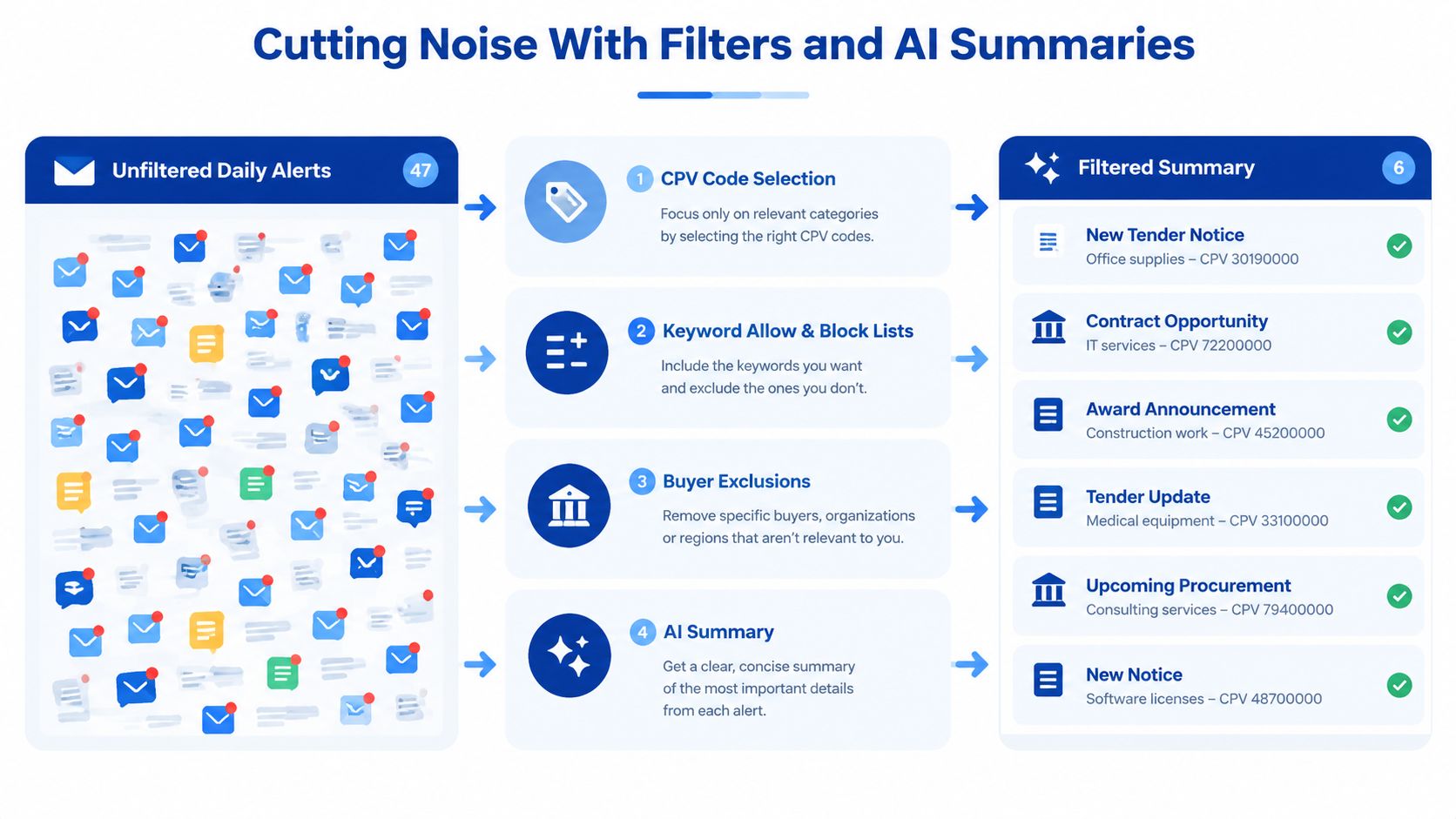
A facilities management supplier might select relevant CPV codes, add “cleaning” and “soft services” as allowed terms, block “vehicle cleaning” and exclude buyers outside its operating region. A separate value band can prevent very small call-offs or oversized national frameworks from dominating the queue.
Build a layered matching rule
Use filters in this order:
- Category first: Select the CPV codes that describe the work, including adjacent services where your credentials support them.
- Language second: Add keyword allow lists for buyer wording, then block terms that repeatedly generate irrelevant results.
- Buyer and region next: Exclude organisations you can't serve, and prioritise councils, NHS bodies or departments with a credible route to delivery.
- Value last: Use value bands as a guide, not an absolute barrier. A lower-value contract may open a local relationship, while a large framework may be unsuitable despite its headline value.
A relevance score should reflect fit, not merely keyword density. A broad framework agreement shouldn't bury a strong local council opportunity because the framework description contains more of your preferred terms.
Use summaries to decide, not to skip the notice
Suppose 40 raw alerts land at 7am. After CPV, keyword, buyer and region rules, six remain. Each has an AI summary covering the scope, deadline and submission route. That doesn't replace reading the procurement documents. It gives the bid manager a faster way to decide which notices deserve a full review.
AI output also needs a controlled prompt, consistent source material and a clear review habit. Teams refining that process can use guidance on how to improve AI results and speed, particularly when summaries feed into later drafting.
Aggressive filtering creates its own risk. If the team blocks every unfamiliar term or sets a hard value cut-off, it may remove a niche contract with a vague title. Adjustable thresholds, saved views and a “borderline” queue give the bid manager a safer way to tune precision without losing discovery.
From Alert to Submitted Bid in Hours Not Weeks
An alert has little commercial value if it sits in an inbox while the team searches for old case studies and compliance documents. The useful workflow starts when the notice arrives and continues through qualification, evidence gathering, drafting, review and submission.
Connect each decision to the next action
The bid manager opens the original notice and records the buyer, deadline, scope, eligibility requirements and likely competitors. A structured go or no-go review then checks capacity, geography, contract fit, pricing prospects and the organisation's capture plan.
If the team proceeds, the knowledge base supplies approved credentials, past responses, case studies, policies and delivery evidence. Bidwell's knowledge base is intended for this type of reuse. The AI response generation step can then produce an initial response from the opportunity requirements and the organisation's stored material.
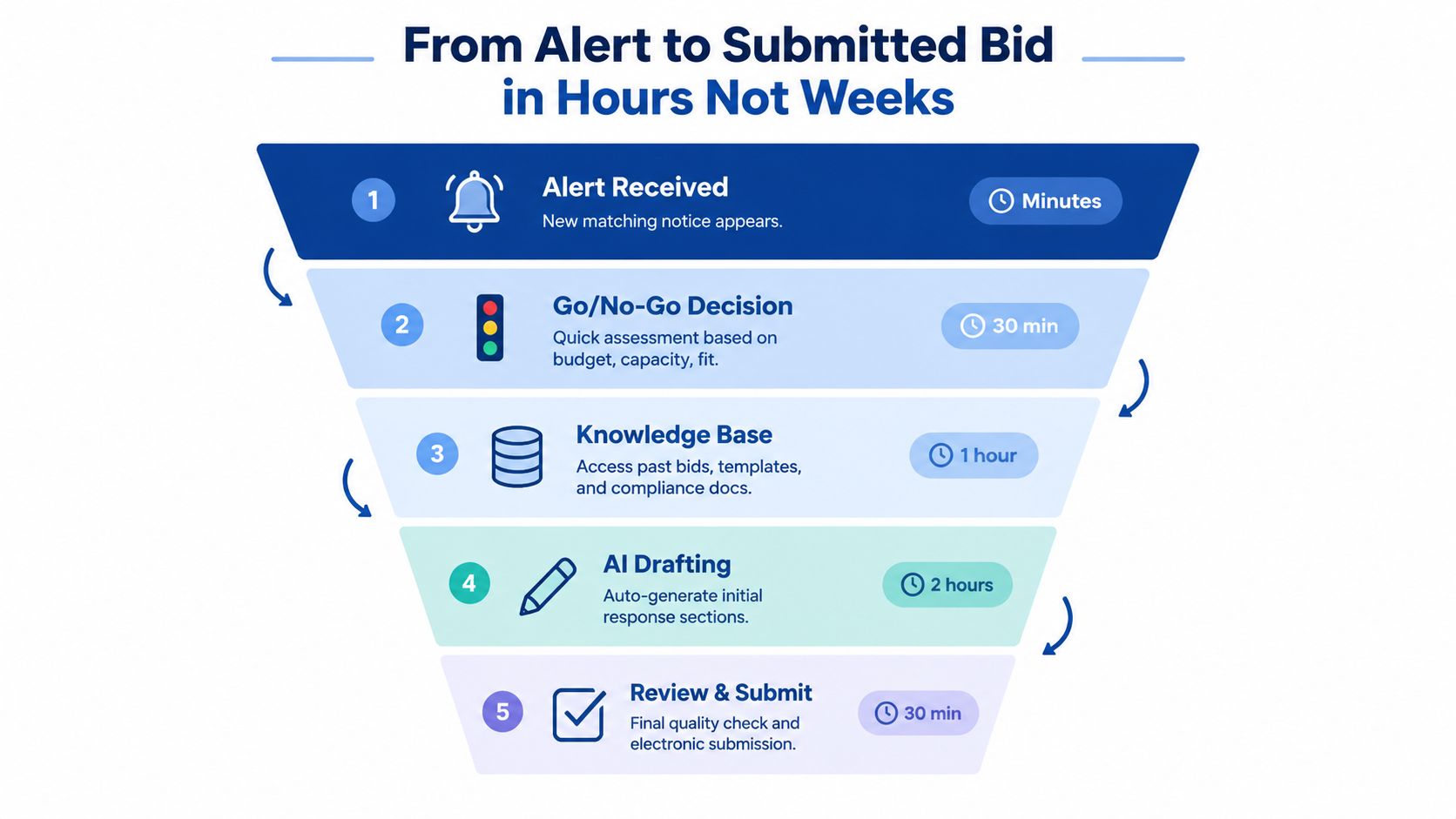
A bid writer still needs to check every answer against the buyer's wording. Subject matter experts must validate operational claims, and finance needs to review the pricing model. The platform can reduce copying, searching and first-draft effort, but it can't decide the right win themes or whether the margin justifies the work.
Where human judgement remains central
The fastest workflow is not the one that removes people. It's the one that gives them the right decision at the right point.
The alert finds the opportunity. The bid team decides whether the opportunity deserves its time.
A connected process can compress a week of coordination into an afternoon for a suitable, well-documented bid. That outcome depends on clean source information, an organised knowledge base and prompt review. Pricing strategy, mobilisation risk, incumbent position and the credibility of the proposed solution still belong with the team.
A Real Two-Week Run at an SME Bidding Team
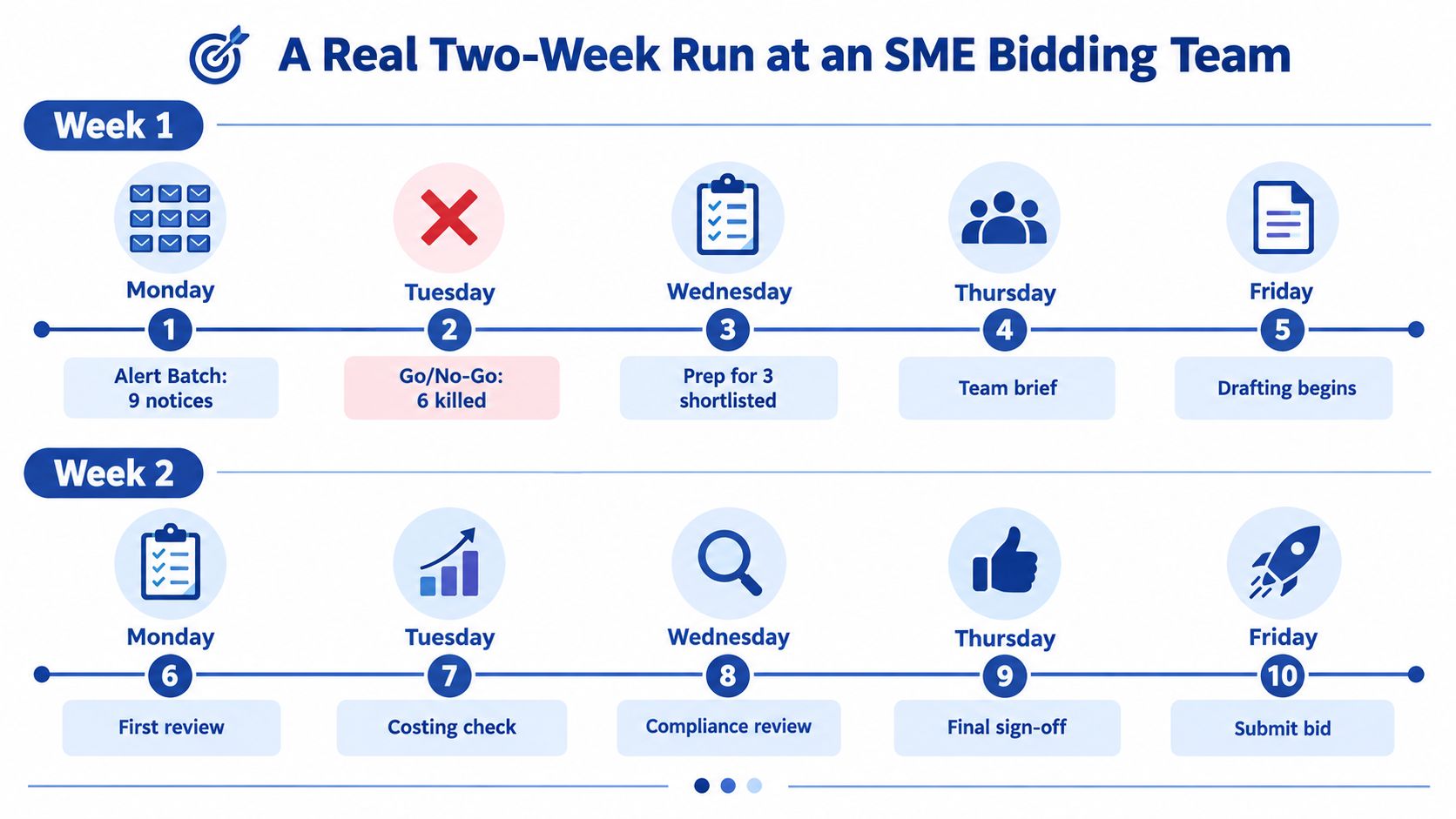
Consider a fictional 12-person facilities management SME with a small bid team and limited operational bandwidth. On Monday morning, the service produces a batch of nine notices across its selected regions and categories. The team doesn't assume all nine are worth pursuing.
Tuesday's go or no-go call removes six. One is too far outside the delivery area, another requires accreditations the company doesn't hold and several demand capacity the operations director can't release. The three retained opportunities move into a shared workspace with owners, deadlines and document requirements.
Week one turns discovery into evidence
On Wednesday, the bid writer pulls relevant cleaning mobilisation examples, staff transfer experience, quality procedures and compliance documents from the knowledge base. Thursday's team briefing gives operations, finance and sales a clear view of the response plan. AI drafting creates a first pass from the buyer questions and approved company material, while the bid writer checks tone, accuracy and evidence.
Friday is not treated as a ceremonial submission day. The team reviews the draft against the scoring criteria, tests the pricing assumptions and identifies unanswered questions. One of the three bids is paused because the likely mobilisation burden doesn't justify the commercial return, despite its strong alert match.
Week two benefits from the first pass
The second week follows a similar pattern, but templates are easier to find and past buyer questions are already organised. A clarification arrives late in the process, and the team answers it from the opportunity dashboard instead of searching email threads.
The alert service saved time at the start and reduced repeated searching. It didn't choose the bid the team walked away from, set the price or approve the final answer. Those decisions came from the people responsible for delivery and commercial risk.
For SME owners, the value of a connected process is practical. You can see how monitoring, evidence and drafting affect workload before committing your team, and Bidwell's SME owner resources frame that workflow around the realities of smaller businesses.
Choosing and Implementing a Tender Alert Service
Start with coverage, not the sales demonstration. Ask the provider to list the official portals and sector sources it monitors, including Find a Tender, Contracts Finder, Public Contracts Scotland, Sell2Wales and eTendersNI where they match your market. UK coverage is rarely uniform. One source may provide cleaner CPV data, while another carries better regional or notice-stage information.
Test the matching layer against notices you already know. Use a won bid, a lost bid, a missed opportunity and an irrelevant notice. The provider should explain why each result appeared, which metadata fields and keywords were used, and how you can adjust the rules. A keyword match alone will not show whether an opportunity fits your capacity, evidence or delivery model.
A practical buying checklist
- Portal breadth: Confirm the sources, regions and notice types included in your plan.
- CPV depth: Check whether CPV codes work alongside keywords, rather than replacing them.
- Delivery control: Test daily digests, more frequent notifications, dashboard access and export options.
- Data ownership: Check your access to saved searches, alert history, notes and exported records if you leave.
- Trial conditions: Run the system against your actual market before accepting a long commitment.
- Workflow connection: Check whether notices can move into qualification, a knowledge base and response generation without manual re-entry.
Opaque ranking is a warning sign. So is an annual contract before a meaningful pilot, or an alert arriving after the response timetable has made the opportunity impractical.
Run the service alongside your existing manual searches during the first week. In the second, tune filters against real results and record why each alert was accepted, rejected or missed. The same discipline used when evaluating wider services for CEOs applies here: test the operating model, not only the feature list.
The long-term benefit comes from feedback. Accepted, rejected, won and lost opportunities can improve future relevance decisions and reveal missing evidence in the knowledge base. Review those outcomes with the people who qualify, price and draft bids, then adjust portal choices and alert rules. This frames the workflow around the practical constraints smaller businesses face and turns a tender alert service into part of a repeatable bidding operation rather than another inbox subscription.
Bidwell combines UK tender monitoring, a searchable knowledge base and AI response generation. Visit Bidwell to see how the platform supports finding, assessing and responding to public-sector opportunities.