The biggest mistake in UK public procurement is treating the tender as the moment that matters. By then, a lot of the decisive work is already done, because the government's lifecycle runs through planning, tender, award, contract, and implementation, and the rules on notices and transparency are built around that wider journey (UK transparency guidance). With the UK National Audit Office estimating £407 billion of public spending on goods and services in 2023 to 24, this is a commercial system that rewards suppliers who prepare early and keep watching after the award (NAO commercial lifecycle guidance).
The UK Procurement Lifecycle at a Glance
The five-stage view is the one that matches how UK public procurement works on the ground. Planning comes first, then tender, then award, then contract, then implementation. By the time the ITT lands, the buyer has often already fixed scope, lots, and criteria, so the live tender is the middle of the story rather than the start.
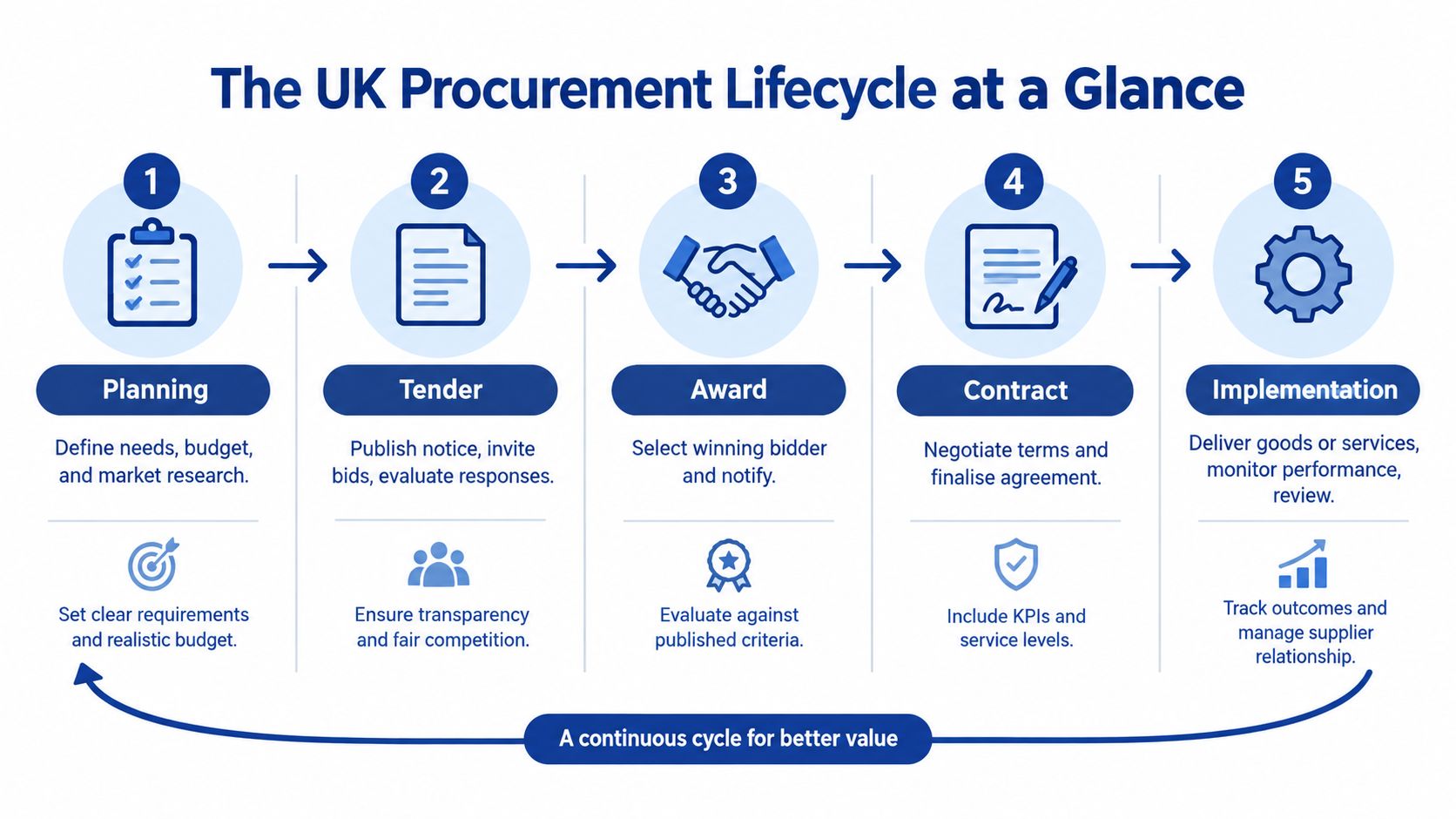
The government's current structure, Plan, Define, Procure and Manage, is more useful for day-to-day bidding because it shows where the buyer makes the decisions that shape your bid. Scope, lotting, route to market, award criteria, mobilisation, and contract management are all set across that lifecycle. The Procurement Act 2023 guidance collection is the cleanest reference point for the official structure.
The practical point is simple. If you only watch the published tender, you are already late to several of the decisions that matter most.
Practical rule: track the notice trail before the tender opens, then keep watching after award. Supplier access is often decided in those quieter stages.
A useful way to work this is as a continuous loop, not a one-off competition. Planning can surface a need through early notices, the tender stage opens the competition, award shows what was scored and why, and implementation shows how the buyer manages suppliers. That last stage is where many guides cut corners. Post-award obligations, reporting, service reviews, and change control can decide whether the contract is commercially workable.
Bidwell fits into that loop by combining tender monitoring, a knowledge base, and AI response generation, so teams can act earlier and reuse evidence instead of rebuilding everything from scratch. For a broader bidding framework alongside this lifecycle view, the procurement in IT playbook is a useful adjacent read, especially if you sell services or technology into the public sector. For a more hands-on reference point, the Bidwell guides library keeps the stages and documents in one place.
Stage 1 Planning and Pipeline Intelligence
Planning is where the buyer defines the need, looks at the delivery model, and studies the market. For suppliers, that means the earliest useful signals are rarely in the live tender list. They're in pipeline notices, pre-market engagement, and any early publication that shows the authority is thinking ahead.
The clearest example is the UK1 pipeline notice. It covers contracts valued at £2 million or more that an authority plans to award in the following 18 months, and organisations expecting to spend at least £100 million on contracts in the coming year must publish it annually between 1 April and 26 May (Procurement Act notices guidance). That's not a live bid invitation, but it gives you time to decide whether to pursue the opportunity and what evidence you'll need.
What to watch before the ITT
The useful signals at this point are usually modest, but they're actionable. A pipeline notice says something is coming. A preliminary market-engagement note says the buyer is testing ideas. An old contract nearing the end of term can tell you where renewal pressure may appear later.
- Pipeline notices: treat them as a cue to build a six-month bid plan, not as a reason to wait.
- Market engagement: use it to shape your position on scope, risk, and delivery, because those choices often harden later.
- Historic award and implementation patterns: use them to understand what the buyer values after the contract starts, not just what they claim to want in the tender.
A lot of SMEs miss this stage because they only monitor live opportunities. That's a mistake, because planning information can tell you whether to invest in a bid, which client references to prioritise, and whether you need a partner. Bidwell's tender monitoring can surface UK1 pipeline notices alongside later UK4 tender notices, so your team isn't starting on the day the ITT drops.
The planning stage is where buyer-side design starts to become supplier-side risk.
That's why this stage isn't just about awareness. It's about direction. If the early notice points to a niche lot, a framework renewal, or a buyer with a strict delivery profile, you can decide much earlier whether the opportunity is realistic for your size and capability.
Stage 2 Defining the Requirement and Sourcing Route
Define is where the buyer converts a need into a procurement strategy. That means the route to market, lot structure, draft contract, conditions of participation, and award criteria all start to take shape. Once those are fixed, they become the rules you'll be judged against.
A UK3 planned procurement notice can be published at least 40 days, but no more than 12 months, before the tender notice to qualify for the shorter 10-day tendering period (Procurement Act 2023 notices). That notice tells you more than “something's coming.” It tells you that the buyer has a procurement calendar, and that your prep time may be shorter than you'd like if you ignore it.
The decisions that matter here
This is the stage where lotting and eligibility get decided. If the buyer splits the work badly, an SME can be boxed out. If they set turnover, insurance, or experience requirements too high, the field narrows before evaluation even begins. If they write vague KPI language, you inherit the risk later.
The practical question is simple. Can you compete on the published terms, or are you being priced out by structure rather than capability?
A few things deserve close attention in the documents:
- Conditions of participation: check pass or fail requirements before you spend time on scoring responses.
- Lot structure: see whether the work is split in a way that fits your delivery model.
- Award criteria: identify what the buyer will score, not just what they say they want.
- Contract risk allocation: look for liabilities, service levels, and reporting demands that change the commercial picture.
Your internal decision-making should be disciplined. If the scope, risk, or mobilisation demands don't fit your delivery model, a well-written bid won't fix that. Bidwell's knowledge base is useful here because it keeps credentials, case studies, and past responses ready for reuse, so you can answer the Define-stage requirements without rebuilding your evidence every time.
Stage 3 Running the Tender and Submitting a Response
The UK4 tender notice is the point where the bid clock starts. It tells you bids are open, and the tender documents tell you exactly what the buyer will accept. At this stage, execution matters more than market positioning.
The minimum tendering period depends on how the authority has structured the process. Under the Procurement Act 2023, the standard minimum is 25 days when tenders are submitted electronically and all associated documents are supplied with the notice (Procurement Act 2023 e-learning). Longer minimums of 30 days and 35 days apply under the same guidance depending on how documents are released and how tenders are submitted. A 10-day period can also apply where a qualifying planned procurement notice was published in the right window, or where urgency makes a longer period impractical.
| UK minimum tendering periods under the Procurement Act 2023 | ||
|---|---|---|
| Submission method | Documents supplied at notice? | Minimum period |
| Electronic tender | Yes | 25 days |
| Electronic tender | No | 30 days |
| Paper tender | Yes | 30 days |
| Neither of the above | No | 35 days |
| Qualifying planned notice used | As applicable | 10 days |
That table only helps if you use it early. If you know the period up front, you can split the workload properly, assign word counts, and leave time for approval. If you do not, the final two days turn into a scramble.
A compliance matrix is the safest way to avoid missed requirements. Map every scored and pass or fail item to one piece of evidence, then write the response against that evidence. Evaluation has to follow the published criteria, and assessment summaries need to show why a tender succeeded or failed. Authorities cannot safely invent new scoring factors after bids are submitted.
Practical rule: if a requirement cannot be traced to one response owner and one source document, it is not ready.
Bidwell's AI response generation fits neatly here. If your knowledge base already holds credentials, case studies, and previous answers, drafting can shrink from a 20 to 40 hour writing job to 2 to 4 hours of review and refinement. If you want to see how AI-assisted drafting works in practice, the bid writing software overview walks through the knowledge-base-to-response workflow.
Pair the compliance matrix with outbound coverage of government contracting leads so pipeline and bid work run off one calendar. The bid still needs disciplined evidence and a clear compliance matrix.
Open Procedure vs Competitive Flexible Procedure
Not every tender journey looks the same. The open procedure is the simplest path. Suppliers submit tenders directly, and the authority evaluates them against the published criteria without building extra stages into the process.
The competitive flexible procedure is broader. It can include any number of stages or supplementary processes, such as an initial participation stage, shortlisting, dialogue, negotiation, and final tender submission (Procurement Act 2023 guidance on competitive tendering procedures). That flexibility helps buyers shape the process around complex requirements, but it can also mean more evidence, more interactions, and more time pressure for suppliers.
How to tell which journey you're in
The tender documents will tell you. Don't assume a familiar label means a familiar process. Read the procedure section first, then look at the sequence of stages and any participation requirements.
In an open procedure, the work is usually straightforward. You respond once, the buyer scores it, and you wait. In a flexible procedure, you may need to pass a participation gate before you even reach the final tender stage, so your early evidence package matters as much as the polished submission.
The participation stage is especially important if the buyer uses the 25-day participation period noted in the guidance for a competitive flexible procedure. That window changes how you gather references, certificates, policies, and other evidence. If you only begin collecting documents after you've finished drafting the response, you're already behind.
For suppliers, the trade-off is clear. Open procedures are leaner and easier to plan. Flexible procedures can suit more complex services, but they demand tighter project management and faster internal sign-off. Your knowledge base should be organised around both formats, not just one, because the document set and question flow can change quickly.
Stage 4 Evaluation Award and Standstill
Evaluation is where the buyer scores the bid against the published criteria, checks the conditions of participation, and then sends the assessment summary to each tenderer. Clarifications belong here too, but they should stay inside the rules that were already published. If the buyer tries to introduce a new evaluation factor after submission, that's a warning sign.
The assessment summary is more useful than many bidders realise. It shows how the authority viewed your offer against the criteria it published. If you read it carefully, you can usually see whether the issue was a missing piece of evidence, a weaker method statement, or a commercial assumption that didn't fit the buyer's brief.
What good challenge discipline looks like
Standstill applies where relevant, and the award notice must be published before the contract is entered into. That sequence matters because it creates a final check before signature. If you believe the scoring was inconsistent with the published method, this is the point to act.
A few habits help here:
- Read the scoring pattern, not just the comments. Short comments can still reveal where the evaluator wanted more evidence.
- Separate clarification from challenge. Clarification windows are for resolving ambiguity, not re-arguing the whole bid.
- Capture the feedback immediately. Once the contract is signed, teams forget the detail fast.
- Store the award outcome in your knowledge base. That gives you a cleaner starting point for the next bid.
This stage often exposes how buyers really think about value. A strong response can still lose if it doesn't mirror the structure of the criteria or if the evidence is too generic. That's why a tidy answer is not the same thing as a scored answer.
Stage 5 Contract Mobilisation and Ongoing Management
The signature is where the commercial reality starts. Mobilisation, performance monitoring, supplier management, benefits realisation, and eventual close or renewal all sit inside the procurement lifecycle, and contract management guidance from Cabinet Office makes that point plainly. If a team treats award as the finish line, it misses the work that decides whether the deal delivers.
The post-award side matters because the authority still has to manage SME barriers, lotting, and payment practice, while some pre-award requirements are now looked at more closely in policy and challenge discussions (Government Commercial and SME guidance). A win can turn into a difficult contract fast if the supplier cannot fund mobilisation, staff the contract, or absorb the reporting load.
What to verify before you sign
Mobilisation is where the bid promise becomes a delivery plan. Check the KPI set, service credits, change control, subcontractor obligations, invoice timing, and any extension or exit terms. If the contract assumes a resource model you cannot stand up, the win becomes a strain.
A bid that looks fine on paper can still be a bad contract if cash flow, reporting load, or service levels do not match delivery capacity.
That is why this stage deserves formal attention from the bid team, not just operations. The signed contract, mobilisation plan, and early performance data should sit in the procurement record alongside the tender file. Bidwell's procurement manager guidance is a practical place to keep that material organised, because the same evidence will shape renewal, re-compete, and future method statements.
The biggest trap is assuming the contract stays stable once awarded. It does not. Payment cycles, scope changes, and performance expectations all move, and the suppliers who keep clean records handle renewal and handover without drama. If you are not tracking implementation, you are missing the part of procurement that shows whether the win was worth it.
Quick Reference Lifecycle Map and Bidwell Tie-Back
| Procurement process stages at a glance | Buyer activity | Supplier action | Bidwell support |
|---|---|---|---|
| Planning | Identify need, assess delivery model, analyse market | Watch pipeline and engagement signals, decide whether to pursue | Tender monitoring |
| Define | Set strategy, route to market, lots, criteria, draft contract | Check eligibility, risk, lot fit, and evaluation method | Tender monitoring plus knowledge base |
| Procure | Publish notice, receive tenders, evaluate, award | Build a compliance matrix, draft against published criteria, submit on time | AI response generation |
| Award | Send assessment summaries, publish award notice, apply standstill | Review scores, capture feedback, decide on any challenge | Knowledge base |
| Manage | Mobilise, monitor performance, handle changes, renew or exit | Deliver, evidence KPIs, manage invoices and change control | Knowledge base and tender monitoring |
The pattern is simple once you stop thinking of procurement as a single event. Tender monitoring finds the early signals, the knowledge base keeps your evidence ready, and AI response generation speeds up the drafting when the live tender appears. That combination is what helps you work across the whole lifecycle instead of reacting at the last minute.
If you want a cleaner way to track opportunities, reuse your best evidence, and draft stronger responses without rebuilding every bid from scratch, visit Bidwell. It's built for the exact lifecycle this article covers, from early notices through to submission and post-award learning.