You've found a tender you could deliver, but the notice goes live tomorrow. The specification is still unopened, your technical lead is busy, and nobody's sure whether the buyer expects a single response or a staged competition. That uncertainty isn't administrative detail. It determines how you qualify the opportunity, allocate time, ask questions and build your answer.
UK public procurement is now operating under a new statutory framework. The Procurement Act 2023 came into force on 24 February 2025, replacing the previous regime across England, Wales and Northern Ireland, while Scotland continues under its own rules. The change forms part of the government's Transforming Public Procurement programme, and suppliers need to understand the route used for each opportunity rather than relying on old terminology.
Why the Procedure Choice Matters Before You Write a Word
The first document to read isn't always the specification. It's the tender notice and its procedure description.
An Open Procedure normally means one competitive stage. You receive the requirements, complete the selection information and submit the full tender by the stated deadline. There's no earlier pre-qualification round separating suppliers before the quality and price response.
A Competitive Flexible Procedure can look very different. The contracting authority designs the stages, which might include an initial selection process, dialogue, negotiation, presentations or a final tender. You need to understand the buyer's timetable and decision gates before deciding whether the opportunity is affordable for your team.
That difference changes your bid plan immediately. A single-stage route demands early readiness because your insurance evidence, policies, case studies, CVs, pricing model and method statements may all be required at once. A staged route may reduce the initial response burden, but it introduces another risk. A strong first-stage submission won't help if you haven't reserved capacity for later dialogue or final tender activity.
Read the route as a workload forecast
Procedure choice also affects how you communicate with the buyer. The notice and tender documents will state the clarification process, deadlines, submission method and evaluation rules. Some competitions place substantial weight on technical merit, while others make price a significant differentiator. You can't decide how much effort to invest in mobilisation, social value or delivery methodology until you understand how the response will be scored.
Use the Bidwell guides as part of your early qualification routine, alongside the official notice and tender pack. The practical principle is simple: classify the route before drafting.
Practical rule: If you can't explain the procedure, stages, deadlines and scoring model in a short internal briefing, you're not ready to commit bid resource.
The same discipline applies to your wider operating model. Tendering often exposes weak document ownership, unclear approvals and inconsistent evidence. If that sounds familiar, guidance on how to transform your business operations can help you fix the underlying process rather than repeatedly patching the same bid problems.
The Five Procurement Procedures Under the Procurement Act 2023
The route tells you how the buyer will run the competition. Start by checking whether the contract is above or below the relevant threshold, whether it falls into a special category and whether the notice identifies a framework or other existing arrangement.
The planned route descriptions in many summaries can be misleading under the new regime. The government's procurement material describes a single statutory framework for above-threshold procurement, with key thresholds including £214,904 for goods and services and £5,372,609 for works. The light touch regime has a specific higher threshold of £663,540, as set out in the Cabinet Office's public procurement material. Check the current notice and official guidance rather than assuming an old label still carries the same meaning.
| Procedure | When it applies | SME implication |
|---|---|---|
| Open Procedure | A standard competitive tender where eligible suppliers submit a complete response in one stage. | Prepare the full evidence pack before the deadline. There's no later opportunity to repair missing essentials. |
| Restricted Procedure | A route involving an initial selection or pre-qualification step before invited suppliers submit a tender. | Treat the selection response as a serious bid. Passing it is what gets you into the next stage. |
| Competitive Flexible Procedure | A buyer-designed process with stages suited to the requirement. | Budget for dialogue, presentations, negotiation or revised tenders if the documents require them. |
| Direct Award through an existing framework | A call-off made through an available framework arrangement under its stated rules. | Framework access may be the real gateway. Winning the later call-off depends on the framework terms and buyer process. |
| Direct Award for specific contracts | A non-competitive award where the statutory conditions or relevant circumstances permit it. | Monitoring matters because not every requirement will appear as an open competition, and challenge routes differ. |
Match complexity to capacity
A straightforward, well-defined requirement may suit an open response if you already hold the required evidence. A complex service with several delivery models may create more work under a flexible process, but it can also give suppliers a structured chance to explain how their approach fits the authority's needs.
Mixed contracts need special attention. The official Procurement Act 2023 e-learning on procurement procedures explains that where separable elements aren't split and a mixed contract contains above- and below-threshold elements, the contract must be treated as above threshold and follow the relevant rules.
That's a useful knowledge-base rule for Bidwell users. Store the classification logic with your tender notes, then make sure any AI-generated response reflects the actual procedure rather than a generic template.
How the End-to-End Procurement Workflow Actually Runs
A public tender is a chain of gates. Missing one early gate can make excellent writing irrelevant later.
Start with pipeline monitoring. For new UK procurements, Find a Tender is the central digital platform for above- and below-threshold notices, except below-threshold notices in Scotland. Contracts Finder remains the official place for UK government and agency contracts over £12,000 including VAT, while Find a Tender is generally used for high-value contracts, usually above £139,688 including VAT. The platform split is set out in the official Contracts Finder guidance and the Find a Tender service.
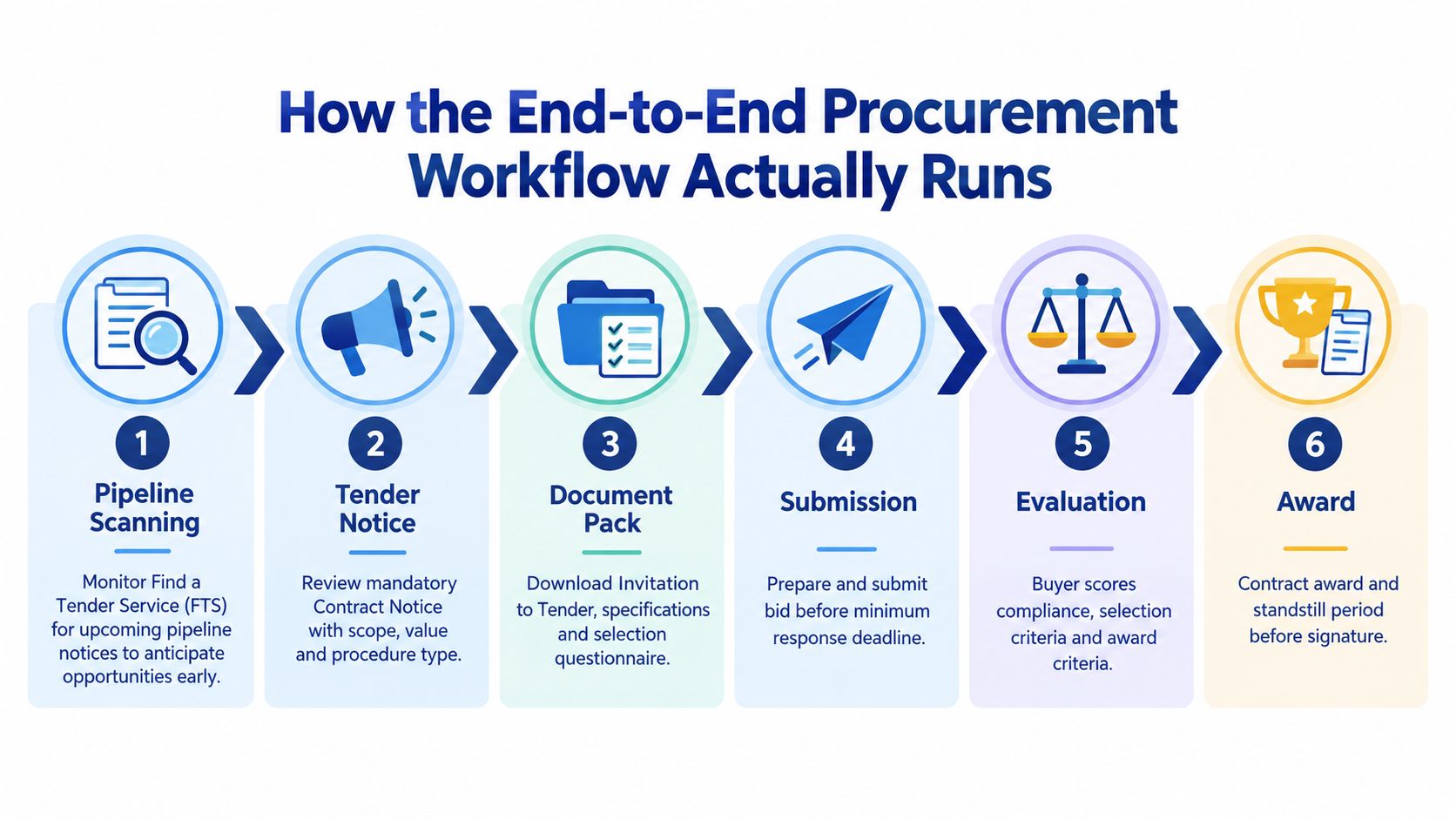
The documents arrive in sequence
The notice gives you the first usable picture of scope, value, procedure and deadlines. Download every document, including the specification, pricing schedule, selection questionnaire, instructions to tenderers, draft contract and social value requirements.
Your working response may contain:
- Selection information: Legal, financial, insurance and technical evidence.
- Method statements: How you'll deliver each requirement, manage risk and measure performance.
- Pricing schedule: The buyer's prescribed format, not your preferred spreadsheet.
- Social value response: Commitments that must be specific, deliverable and measurable.
- Clarification record: Questions asked, answers received and any amended documents.
Submit through the buyer's required portal and in the required format. From 24 February 2025, suppliers may need to provide supplier information and generate a share code or file through Find a Tender, but that doesn't replace the buyer's submission instructions. The official Procurement Act guidance collection makes the practical point clear: you still need to submit the bid exactly as specified in the notice and tender documents.
After the deadline, the authority evaluates compliance, selection criteria and award criteria. Then come the award decision, feedback and the standstill period before signature. Don't assume submission ends the work. Keep your evidence, clarification log and pricing assumptions available for queries, mobilisation and lessons learned. For a broader explanation of how purchasing activity continues from sourcing into payment, the Loopfour AP P2P guide is useful context.
Compliance Checkpoints That Decide Your Score
Many bids don't fail because the methodology is weak. They fail before quality scoring begins.
Consider Northgate Civils, a four-person groundworks firm bidding for a £480,000 highways framework. Its methodology was clear, its programme was credible and its references were relevant. But the insurance certificate expired the day before submission. The buyer treated the missing current evidence as a compliance failure, and the quality of the response never got the chance to compensate.
The example is hypothetical, but the operational lesson is real. Treat each checkpoint as a gate, not as another scoring opportunity.
Four gates to check before writing
Tender notice: Confirm the opportunity, procedure, scope, lot structure, deadline and submission route. If the notice changes, update your bid record immediately.
Response timeline: Record every minimum period and internal deadline. The notice and documents control the timetable, so don't rely on an old open-procedure checklist.
Exclusion grounds: Check mandatory and discretionary grounds, declarations and supporting evidence. Fraud, corruption, cartel conduct and serious performance issues can affect eligibility and future access to public contracts. The government's bid-rigging guidance states that bid rigging can raise prices by 20% or more, with a possible economic impact estimated at £1 billion to over £3 billion. It also explains that illegal cartel activity can lead to exclusion from individual procurements and a central debarment list with automatic exclusion for up to 5 years.
Conflicts of interest: Complete the declaration accurately. Check directors, advisers, subcontractors and relationships that could create a conflict, then ask for clarification if the form is unclear.
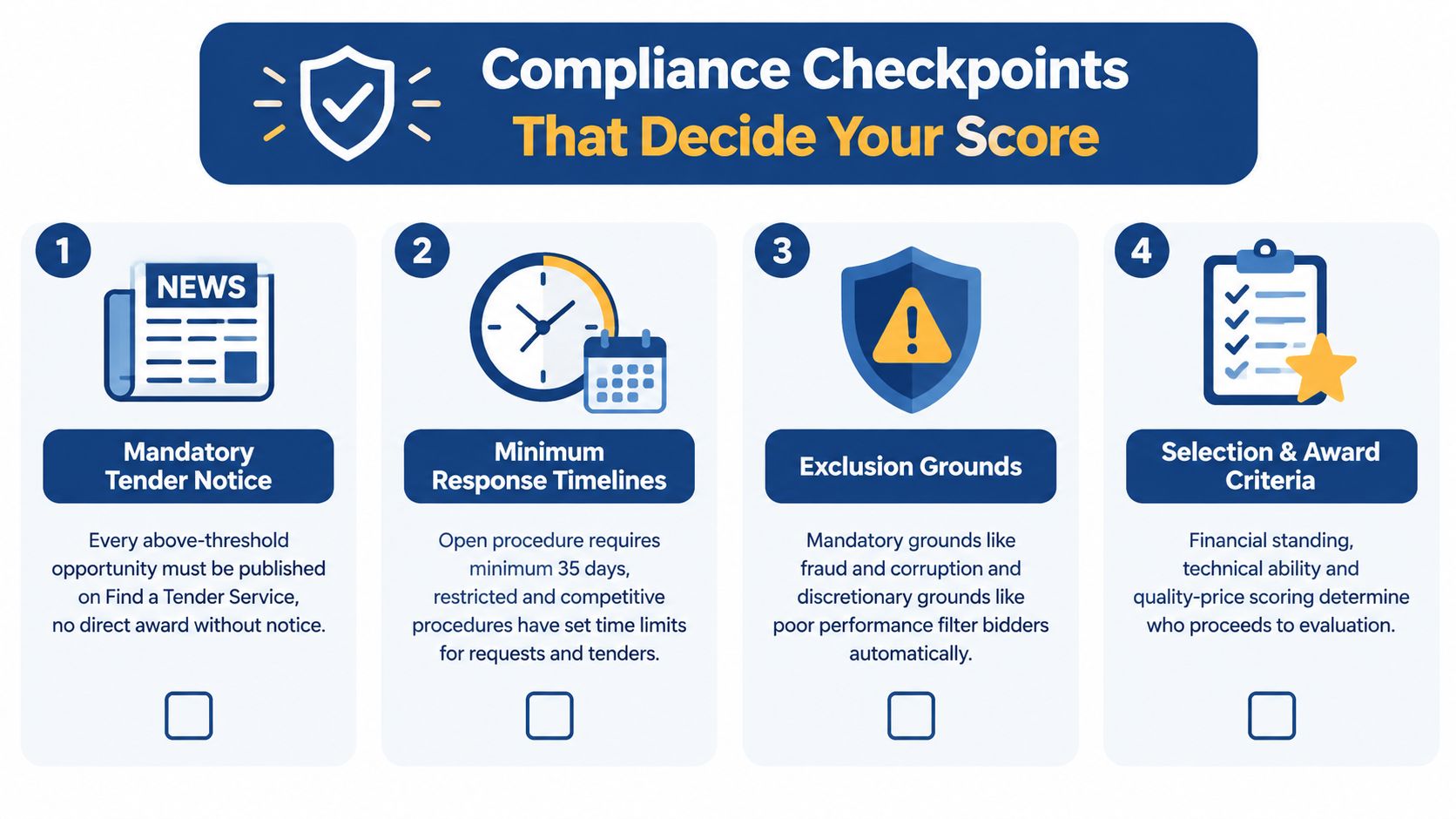
Keep a live checklist beside the bid plan. Refresh it whenever clarification answers, amended documents or deadline changes arrive. A controlled evidence folder also matters. Guidance on best practices for compliance docs is relevant when you're trying to keep certificates, policies and approvals current.
Bidwell's knowledge base can hold approved policies, accreditations and evidence, but it doesn't decide whether your insurance is valid or whether a conflict exists. Your team must make that decision and approve the final response.
Roles, Responsibilities, and Where Bidwell Fits
A tender has two operating teams, even when one side is invisible to you.
The buyer is usually a contracting authority supported by a procurement lead, commercial stakeholders, subject-matter evaluators and, where needed, legal advisers. They define the requirement, choose the procedure, publish the documents, answer clarifications, score responses and issue the award decision.
The supplier needs its own equivalent structure. A small business may combine roles, but the responsibilities still exist.
| Stage | Buyer responsibility | Supplier responsibility | Bidwell support |
|---|---|---|---|
| Planning | Define the requirement, route and market approach. | Decide whether the opportunity fits capability, capacity and risk appetite. | Tender monitoring surfaces relevant notices for review. |
| Sourcing | Publish notices, documents and clarification arrangements. | Download the pack, build a compliance matrix and assign owners. | Monitoring keeps the opportunity in the bid pipeline. |
| Evaluation | Apply the published selection and award criteria. | Submit evidence that answers the stated questions and scoring points. | The knowledge base retrieves approved past answers, CVs, policies and case studies. |
| Award | Issue the decision, feedback and contract documentation. | Review feedback, record lessons and prepare for mobilisation if successful. | Stored bid material supports post-bid learning and future drafting. |
Keep the human approvals visible
The bid manager owns the plan, deadlines, risk register and go or no-go decision. The technical author turns the specification into a delivery response. The commercial reviewer checks rates, assumptions and arithmetic. The approver red-lines the final version and confirms that the business can stand behind every commitment.
Bidwell's tender monitoring can put relevant notices in one working queue. Its knowledge base can organise approved credentials and previous response material. Its AI response generation can produce an initial answer against the specification and scoring criteria for a human to check.
It doesn't submit bids, speak to buyers or make compliance decisions. That boundary matters. AI can reduce repetitive drafting, but the supplier remains accountable for truth, relevance, pricing and submission.
A Realistic SME Bid Cycle Using Monitoring and AI Drafting
Aerial Analytics is a hypothetical six-person drone-survey firm. It has the capability to pursue public sector work, but not the spare capacity to treat every tender as a standalone writing project.
During week one, a monitoring alert flags a new Find a Tender notice from the Environment Agency for habitat mapping. The bid manager logs the scope, checks delivery geography and insurance requirements, reviews the procedure and makes a go or no-go decision. Two other tenders are already active, so the team assigns one technical author, one commercial reviewer and a director as approver across the three bids.
By weeks two and three, the technical author searches the knowledge base for approved methodology, pilot outputs, relevant CVs and environmental policies. AI response generation drafts the first six quality responses against the buyer's questions. The author then corrects technical assumptions and removes material that doesn't fit the specification.
The pressure appears in the middle
In week four, Aerial Analytics submits clarification questions and records the buyer's answers against each affected response. Loose document control causes trouble here. A clarification can change an interpretation, a deliverable or a pricing assumption, so the answer needs to reach every owner.
During week five, the commercial reviewer rebuilds the pricing schedule in the buyer's format. The director red-lines the AI draft, checks evidence, tests the delivery plan and confirms that every commitment is resourced. Submission and final sign-off happen in week six.
The firm plans around three bids, with roughly 18 working days of writing each, completed inside a 30-day minimum timeline with one team. The second and third bids reuse roughly 60% of the first bid's content, halving total response time. Those figures describe this hypothetical operating model, not a guaranteed result for every supplier.
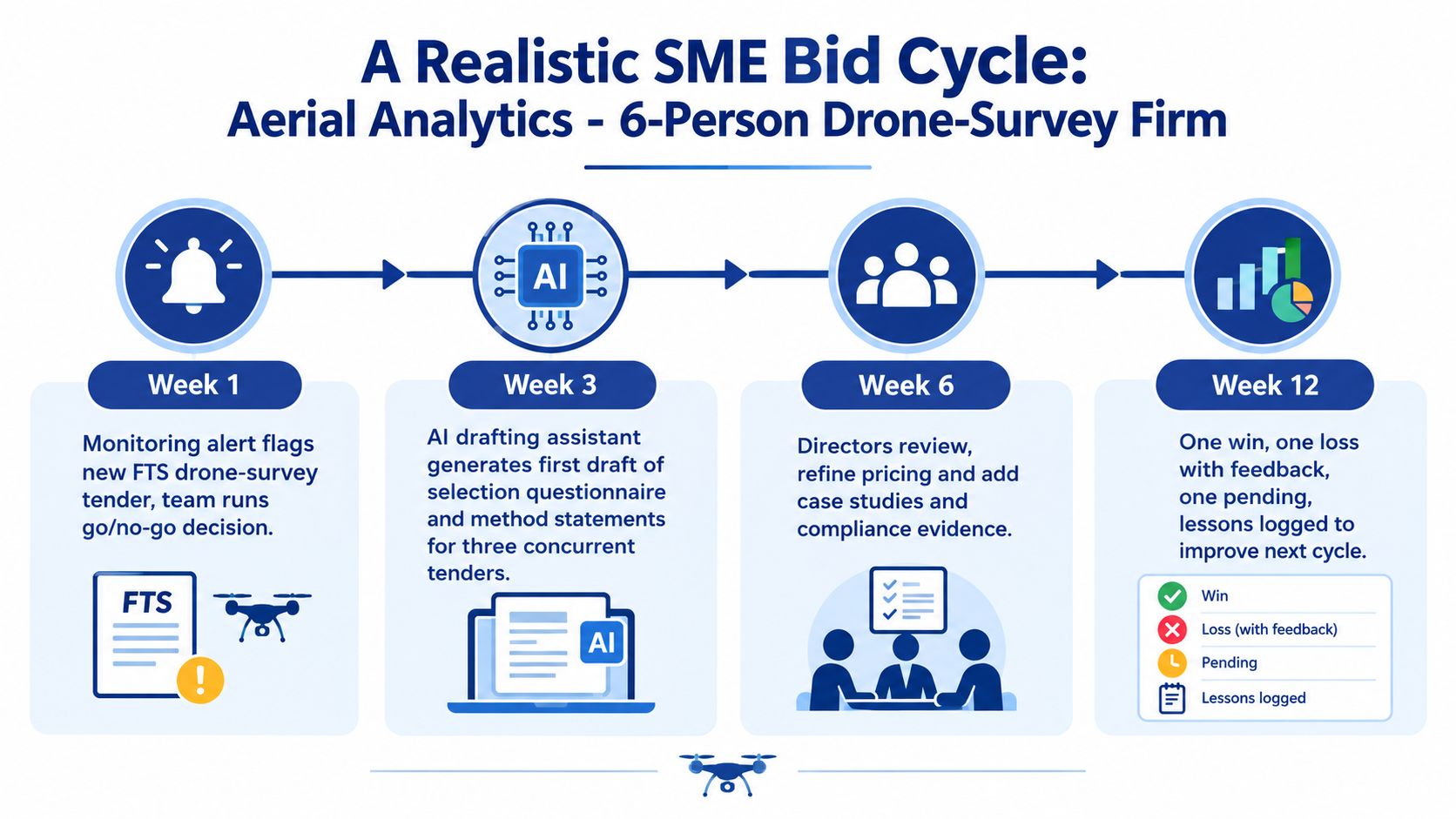
The important point isn't that AI writes the bid alone. It doesn't. The gain comes from combining early tender monitoring, a controlled knowledge base and human-reviewed AI response generation. The bid manager still owns the decision, the author still owns technical accuracy and the approver still owns the commitment.
For an SME owner deciding whether this type of process fits the business, Bidwell's resources for SME owners provide a relevant starting point.
Building a Repeatable Procurement Routine Over a Year
Procurement becomes manageable when you stop treating every notice as an emergency.
Track three useful measures each month: win rate against opportunities pursued, average hours spent per bid and the value of qualified pipeline for the next quarter. The purpose isn't to create a dashboard for its own sake. It's to find out whether your qualification decisions, writing process and evidence library are improving.
Run a weekly pipeline review lasting two hours. Use it to assess new Find a Tender and Contracts Finder opportunities, confirm owners and close decisions on poor-fit work. Keep a monthly compliance refresh for exclusion grounds, conflicts of interest, insurance, certifications and approval responsibilities.
After every submission, update the knowledge base. Correct technical answers, retire boilerplate that performed poorly, improve case-study evidence and record clarification lessons. Review awarded notices and available contract information on Find a Tender and Contracts Finder to inform commercial assumptions, without treating another buyer's price as a direct benchmark for your own costs.
Measure the work that changes outcomes
Hold a quarterly retrospective against the prior three submissions. Ask which questions consumed the most time, where evidence was missing, which assumptions changed during clarification and whether the opportunity should have been rejected earlier.
Ignore vanity measures such as total bids lodged or brochure downloads. They tell you little about fit, margin or delivery risk. A smaller pipeline of well-qualified opportunities is more useful than a crowded list nobody can resource.
Bidwell's procurement software package for the sector brings tender monitoring, a searchable knowledge base and AI response generation into the same bid routine. Used properly, it supports the process, but your team still needs disciplined review, accurate evidence and clear go or no-go decisions.
Bidwell monitors relevant UK tender portals, organises your approved bid evidence and drafts custom responses against procurement requirements for human review. Visit Bidwell to see how its tender monitoring, knowledge base and AI response generation can fit into your next procurement cycle.