
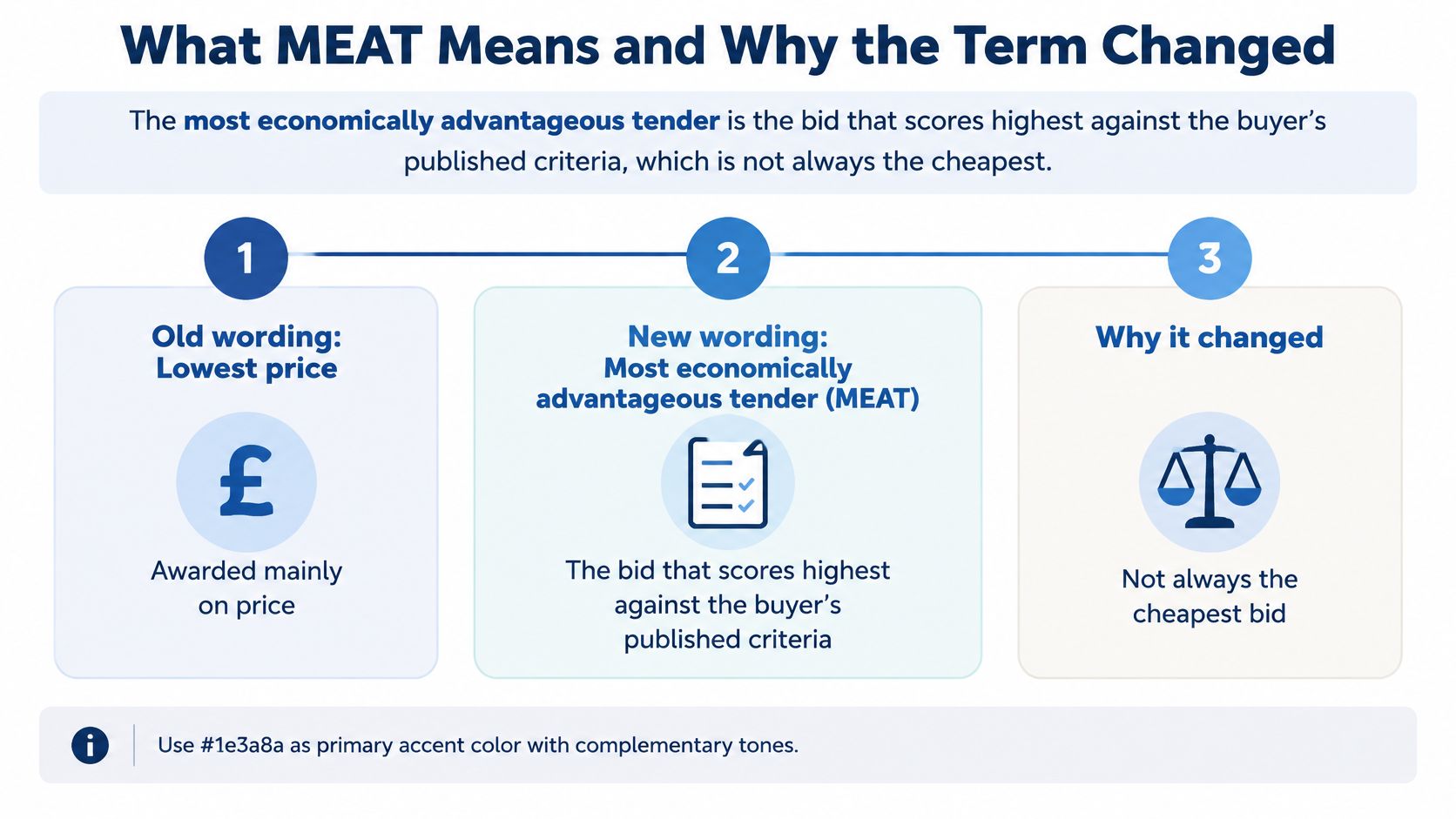
The most economically advantageous tender is the bid that scores highest against the buyer's published criteria, not the cheapest bid. The Procurement Act 2023 now calls it the most advantageous tender (MAT).
Popular advice tells you to sharpen your price and add some quality language around it. That's backwards. If price carries 30 marks and quality carries 60, cutting your margin to chase a mark or two while writing thin method statements loses you the contract.
Read the weighting first. Then decide where your time goes.
What MEAT Means and Why the Term Changed
The most economically advantageous tender is the bid that scores highest against the buyer's published criteria, which isn't always the cheapest. The buyer defines value in advance. Your job is to score against that definition, not your own.
Say you're buying a van for a maintenance team. One van costs £14,000 but has higher running costs and too little load space, so crews make two trips. Another costs £18,000, carries the kit in one trip and costs less to run. The dearer van can be the better buy because it fits the job.
Public buyers score the same way, just with published marks. Price is one block. Quality, delivery and social value sit alongside it.
Where MEAT came from
The government guidance on awarding contracts under the Public Contracts Regulations 2015 required awards on the "most economically advantageous tender" from the authority's perspective. That allowed price or cost, including life-cycle costing, and the best price-quality ratio.
Those regulations also allowed qualitative, environmental and social criteria linked to the contract subject matter. So a bid could win without being cheapest if its combined benefits scored highest. Guidance treated MEAT as broadly the same as best value for money.
That history matters if you're still learning the system. A plain-English primer on understanding UK public sector procurement from Waymap is useful background before you get into scoring detail.
What changed under the 2023 Act
The Procurement Act 2023 guidance on assessing competitive tenders confirms the Act replaced "most economically advantageous tender" with "most advantageous tender" for competitive tendering procedures. The winner must satisfy the authority's requirements and best satisfy the award criteria using the stated methodology and relative importance.
That guidance says the change does not represent a policy shift. Authorities still don't have to award on lowest price, and price doesn't automatically take precedence over non-price factors. MAT just makes that clearer.
- 2015 Regulations: MEAT, price-quality ratio, life-cycle costing.
- Procurement Act 2023: MAT for competitive procedures, same scoring logic.
- After award: assessment summaries to suppliers, then a contract award notice.
Practical rule: read the published method first, because that is how the winner is picked.
If you're sorting live opportunities by fit, it helps to see how tenders are matched and tracked before you commit drafting time. Tender monitoring should surface the notice early enough for that check. The label on the notice matters less than the marks inside it.
How Buyers Split the Marks Between Quality and Price
Start with the split, not the specification. This table shows one real award and the illustrative ranges buyers can use.
Published weightings in MEAT and MAT awards
| Award or range | Quality or technical | Price or cost | Social value | Source |
|---|---|---|---|---|
| GLA Zero Carbon Accelerator (2024) | 60% | 30% | 10% | Find a Tender |
| Central government illustrative range | 0-100% | 0-100% | 10-90% | UK buyer guide |
| Wider public sector illustrative range | 0-100% | 0-100% | 0-90% | UK buyer guide |
No standard split exists
The UK buyer guide with illustrative weightings lists quality or technical solution and price or cost at 0% to 100%, with social value at 10% to 90% for central government and 0% to 90% for the wider public sector. There's no fixed price-to-quality weighting in the Procurement Act 2023.
Don't assume 60:40 or 70:30. I've no interest in guessing when the buyer has printed the answer. Check the notice and tender documents.
Authorities must show the relative importance of each criterion. They can use percentages, a ranking, or another clear method. Percentages are easiest to plan against because you can convert them straight into marks.
Turn percentages into drafting time
Say quality is worth 60 marks in a worked example. A 10-mark question is one sixth of that block. It deserves roughly one sixth of your quality drafting and review time, not the same effort as a 2-mark policy question.
- Largest block first: draft and review it while you're fresh.
- Small questions: answer them fully, but don't spend a day polishing 3 marks.
- Price block: work out what a price cut buys in marks before you offer it.
Buyers choose the balance that suits the contract. A commodity buy may weight price heavily. A complex service usually weights method, staffing and risk more, because failure costs more than a small saving.
Marks decide effort, not habit. If you're writing every answer to the same length, you're misallocating time.
Use tender monitoring to capture the weighting from each notice as it arrives. Keep it with the deadline and value in one place. Then your knowledge base can supply evidence for the biggest blocks, and AI response generation can draft around the actual marks available.
Find the weightings before you read the specification in detail. They tell you whether this is a price fight, a quality contest, or a mix you can realistically win.
Social Value Weightings and How to Score Them
Social value isn't a feel-good appendix. For central government contracts under the Social Value Model, it's scored marks. Lose them and a strong technical bid can still finish second.
Minimum social value weightings under the Social Value Model
| Contract value (central government) | Minimum social value weighting | Scoring note |
|---|---|---|
| £1 million to under £5 million | 10% | Scored within the quality assessment |
| £5 million or more | 20% | Scored within the quality assessment |
The government guidance on using PPN 026, the Social Value Model sets minimums of 10% for contracts valued at £1 million or more but below £5 million, and 20% for contracts valued at £5 million or more. It also applies the requirement within the quality or non-price assessment when an absolute method such as Price per Quality Point is used.
So the commercial formula doesn't make social value disappear. It's inside the score either way.
Weak promise, strong commitment
A weak answer says "we will support local jobs". An evaluator can't measure that. There's no number, no date, no owner and no baseline.
A strong answer says you'll deliver eight apprenticeships for residents in the authority's area by month 12, reported quarterly against a zero baseline. That's hypothetical wording, but the structure is what scores. The evaluator can see what happens, when, and how you'll prove it.
Every commitment needs four parts:
- Policy outcome: name the outcome the buyer has chosen, in their words.
- Baseline and output: where you start, and the measurable result you'll deliver.
- Owner and date: a named role responsible, with a deadline.
- Resource: the staff time or budget priced into your delivery plan.
Don't promise what you haven't priced
Unquantified promises reduce your effective score. Inflated promises are worse, because you'll be held to them in delivery and they may not look credible at evaluation. If your implementation plan has no time for the apprenticeships you've promised, evaluators notice the gap.
I would keep verified social value figures in your knowledge base. Store past apprenticeship numbers, local spend and volunteer hours with dates and evidence. Then AI response generation can pull real figures into a draft instead of inventing fresh claims each time.
Match the commitment to the contract. A cleaning contract can credibly offer local recruitment and training. It can't credibly promise to build a community centre. Proportionate, measurable and resourced beats grand every time.
A Worked Scoring Example Where the Dearest Bid Wins
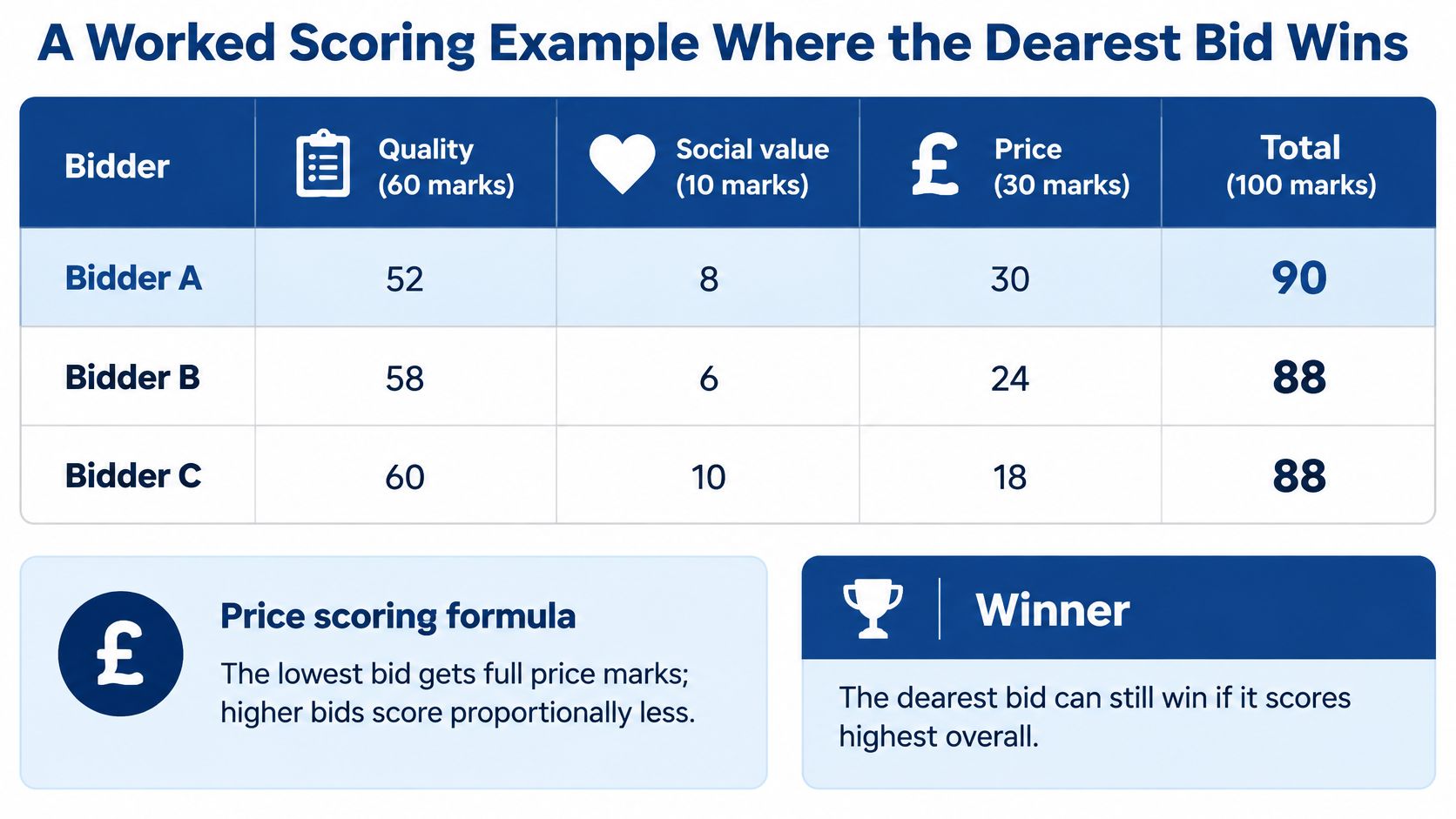
This structure isn't invented. In 2024, the Greater London Authority Zero Carbon Accelerator award on Find a Tender was weighted 60% for quality and technical factors, 10% for social value, and 30% for commercial price. The worked example below uses that same split with hypothetical bidders.
Worked scores for three bids
| Bidder | Quality (of 60) | Price marks (of 30) | Social value (of 10) | Total |
|---|---|---|---|---|
| Bidder A | 42 | 30 | 7 | 79 |
| Bidder B | 50 | 28.2 | 8 | 86.2 |
| Bidder C | 56 | 26.1 | 9 | 91.1 |
The price formula
The lowest bid gets full price marks. Every other bid scores lowest price divided by its own price, multiplied by 30.
Bidder A bids £800,000 and gets 30 price marks. Bidder C bids £920,000. That's £800,000 divided by £920,000, multiplied by 30, which gives 26.1 marks. Being £120,000 dearer costs C only 3.9 marks.
Bidder B sits between them at a hypothetical £850,000, which gives 28.2 price marks. Solid quality, decent social value, total 86.2. Good, but not enough.
Where the contract was actually won
Look at quality. C scores 56, A scores 42. That 14-mark gap is worth more than three times the price gap. Add C's extra 2 social value marks and the result isn't close.
The price gap cost under four marks. The quality gap cost fourteen. That is the trade most losing bidders never calculate.
A did nothing wrong on price. A lost because its method statements were thinner, its evidence weaker, or its answers missed sub-criteria. Shaving another £20,000 off wouldn't have fixed that, it would have gained nothing since A already held full price marks.
Variations you need to check
Not every buyer uses this exact formula. Some use a cap, a banded scale, or a different curve where scores drop faster as price rises. The notice should state which applies, so run your own arithmetic with their formula, not this one.
Watch abnormally low bids too. A price that looks undeliverable invites questions before award, and a buyer can reject a bid it isn't satisfied can be delivered. A very low price can lose more than it gains.
The lesson is simple. Work out what a price cut buys in marks, then compare it with what better answers buy. Usually the answers win.
Check the Weightings and Build Your Response
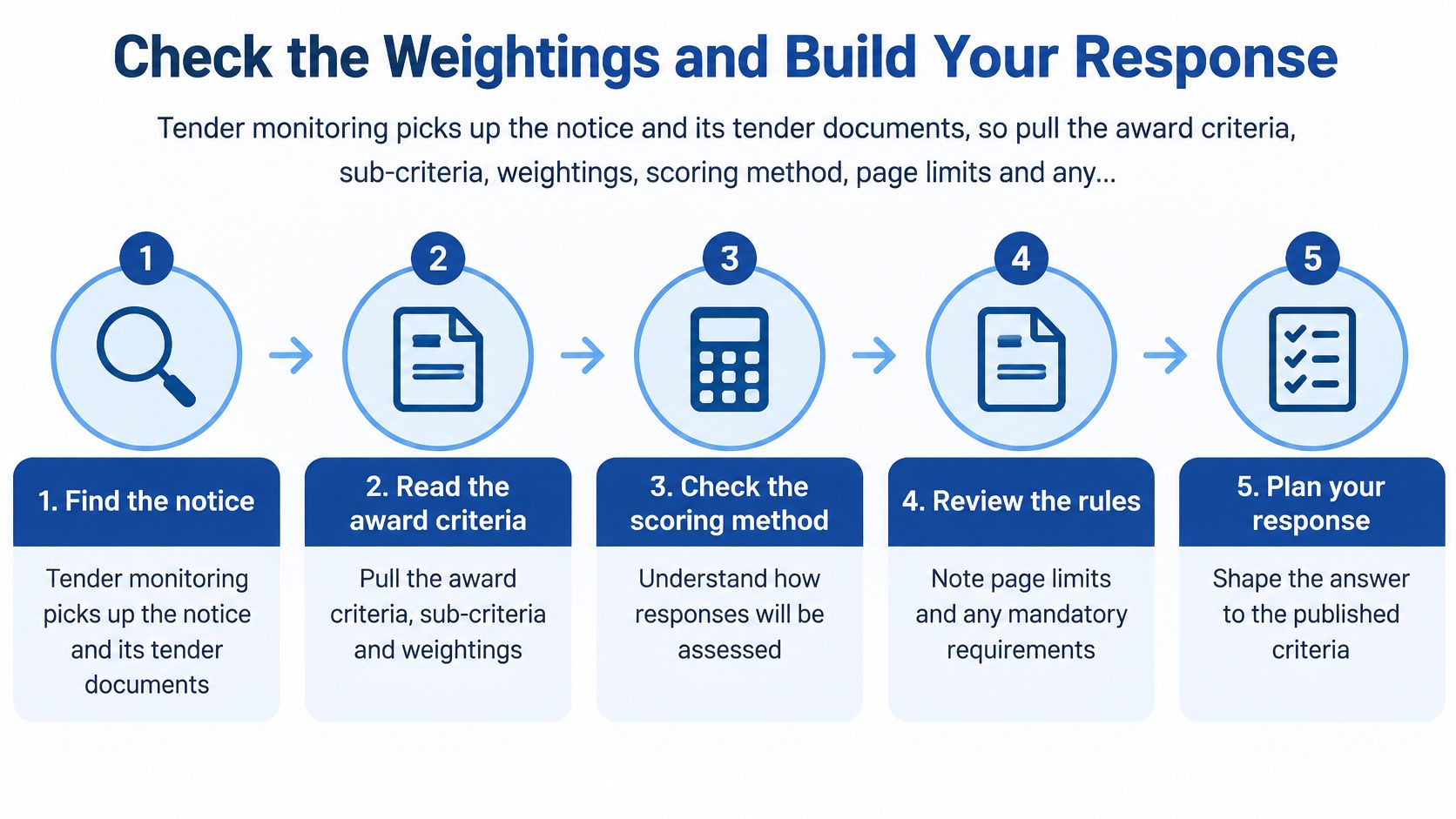
Start with the decision, not the drafting. Tender monitoring picks up the notice and its tender documents. Pull the award criteria, sub-criteria, weightings, scoring method, page limits and any ranking before you open the specification.
Check the quality, price, and social value marks total 100. Note where the largest blocks sit. Then ask the go or no-go question. Can you credibly score well on those biggest blocks with evidence you have?
Our Discover stage watches every UK tender portal, matches tenders by CPV code, keyword, region and value, and emails only the tenders that fit. We also score each UK tender we find against the customer's knowledge base. That gives you an early read on whether your evidence matches the marks on offer.
If the biggest block is a method statement for work you've never delivered, that's a no-go, however attractive the value looks. If your case studies map cleanly onto the top three criteria, bid.
The eight steps
Build a compliance matrix. One row per criterion, with its marks and word or page limit. Every mark gets a clear home, and nothing gets answered twice while something else is missed entirely.
Answer the criterion in your first sentence. If the question asks how you'll manage mobilisation risk, sentence one says how, not who you are. Evaluators scan for relevance before they read for detail. Company history can wait for the question that asks for it.
Attach evidence to each row. Pull case studies, credentials and past results with figures from your knowledge base. A claim without a number or a named contract is just an opinion. Tag the evidence to the row so the drafter isn't hunting through folders mid-bid.
Allocate drafting time by marks. A 30-mark method statement gets days. A 5-mark policy question gets an hour and your existing policy. Write this allocation down before anyone starts, or the easy questions will eat the week because they're pleasant to write.
Draft the price narrative. Explain how the price links to quality and delivery. Where does the money go, what does it buy the buyer, and what risk does it remove? A pricing schedule with no explanation leaves the evaluator to guess whether you're cheap because you're efficient or because you've missed something.
Set out social value properly. Baseline, measurable output, named owner, date. Use the structure from the scoring rules, and make sure the commitments appear in your resourcing plan too. If they're not in the plan, they're not real.
Use AI response generation to draft, then check. Generate each answer from the evidence in your knowledge base, shaped to the criterion wording. Then check every matrix row against the draft line by line. Generative drafting is fast, but it will happily write a fluent answer to a slightly different question if you don't check. Tools built for this, such as bid writing software, should draft against the actual notice, not a generic template.
Confirm the basics before submission. Every mark has an answer. Every answer matches its criterion. Page limits hold, file names match the instructions, and the pricing schedule totals agree with the narrative. Customers review, polish and submit the drafted tender themselves, so this final check is yours and it matters.
Why this order works
Build the matrix before you write a word. It turns a vague sense of what the buyer wants into a list of marks you can tick off.
Most bids fail in planning, not prose. Teams start writing the answer they know best, run long on it, then rush the 30-mark question on the final day. The matrix stops that, because the effort plan exists before the writing starts.
Keep the matrix live during drafting. When a clarification changes a weighting or adds a sub-criterion, update the row and reallocate time the same day. A matrix that's wrong by week two is worse than none, because people trust it.
Pitfalls That Lose Marks and the Legal Limits
The most common way bids lose marks is dull. Answers are written for a generic buyer, so evaluators can't match them to the criterion. The content may be fine. It just doesn't answer the question printed above it.
The usual mark-losers
- Ignoring sub-criteria: a 20-mark section answered in one paragraph, so most of it scores zero.
- Social value without a baseline or owner: promises an evaluator can't measure or trust.
- A price narrative that never explains the price: figures with no link to quality or delivery.
- An abnormally low price with no delivery plan: cheap and undeliverable reads as risk, not value.
- Recycled answers: past text naming the wrong buyer or carrying outdated figures.
- Exceeding page limits: the excess is usually ignored, including the evidence you put there.
Support built for bid managers helps with the checking discipline, but no tool fixes an answer aimed at the wrong criterion. That judgement sits with you.
The legal boundaries
Award criteria must relate to the contract subject matter. They must be clear, measurable, specific and proportionate. Authorities must publish their assessment methodology and say whether failing a criterion could disqualify a bid.
UK case law on departing from published marking schemes and using undisclosed criteria is strict. Check any case against the official judgment before you rely on it. This is general information, not legal advice, so get a solicitor if you're considering a challenge.
If the scoring looks inconsistent with the published method, request your assessment summary and raise it within the time limits the Act sets. Don't sit on it.
Whatever you decide about a past result, fix the next bid now. Pick one live tender this week. Build its compliance matrix before reading any other document, so you know what each mark is worth before you spend an hour drafting.
If you're tired of guessing which marks matter, Bidwell combines tender monitoring, a searchable knowledge base and AI response generation so each draft is built around the buyer's published weightings. Find a live tender, check its criteria against your evidence, and draft the response in hours, then review and submit it yourself.

