
Healthcare and social-work SMEs collectively earned £14 billion directly from the UK public sector in 2024, according to Tussell's SME Procurement Tracker. That's a substantial market, but writing a convincing proposal is only part of reaching it. You need to find the right notice, establish that you can deliver, and submit answers you can defend.
For UK suppliers, request for proposal software should connect those jobs. A polished writing workspace isn't enough if you miss a suitable contract or submit an unsupported claim.
Why Bid Teams Outgrow Spreadsheets
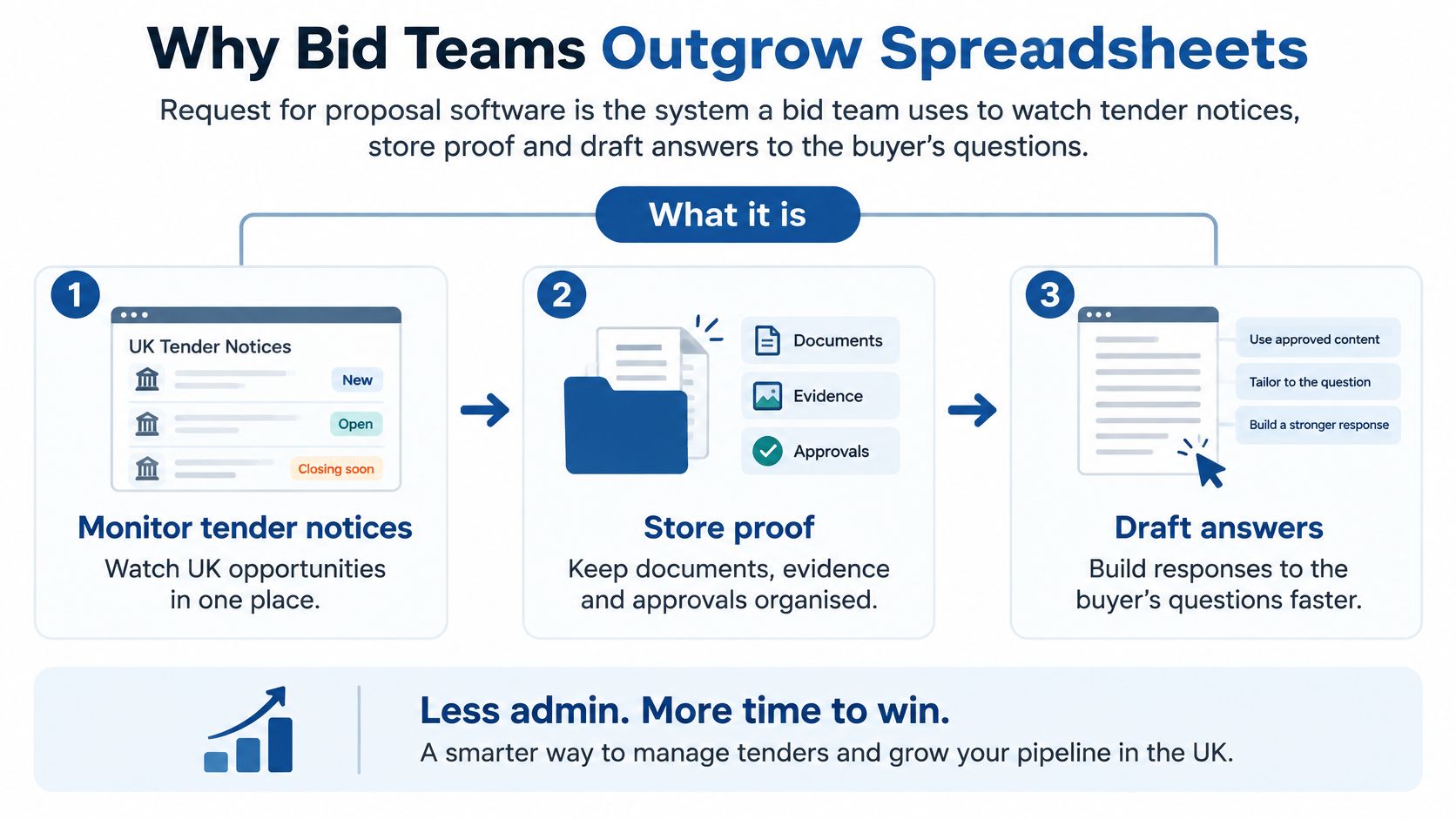
A spreadsheet can price a bid. It can't reliably manage notice coverage, reusable evidence and answer approvals in one workflow. Request for proposal software should help bid teams handle all three, especially when tender work competes with delivery.
An operations director might spot a facilities contract between meetings. Before the team can respond, someone still needs to check eligibility, find an approved case study and confirm who will review the answers. The workbook doesn't assign those jobs.
In 2024/25, Contracts Finder recorded 14,415 contract opportunities and published 58,352 award notices, while Find a Tender published a further 21,640 award and contract notices, according to the Public Procurement Review Service progress report.
Storage isn't the problem to solve
Manually checking every notice isn't practical alongside live bids and delivery work. Award notices serve a different purpose from open opportunities: they show who received work, rather than what suppliers can apply for.
Many public-sector suppliers are small firms. Spreadsheets can still support straightforward costing; resources for quoting with spreadsheets can help keep quotation work organised. The strain starts when the same workbook must also track notice changes, evidence ownership and answer approvals.
Check whether the software connects these jobs:
- Tender monitoring: Find relevant opportunities without repeating portal searches.
- Knowledge base: Keep approved evidence ready for future responses.
- AI response generation: Draft against the actual questions using that evidence.
Buying filter: If a product only helps after someone finds the notice, it leaves tender coverage unresolved.
RFP RFQ and RFI Software Compared
What each buyer document asks of the software
| Document | Buyer wants | Typical effort | Software must |
|---|---|---|---|
| RFI | Market information and capability, usually no price or contract | A short questionnaire | Store standard answers and show missing evidence |
| RFQ | A price for a written specification | A pricing schedule, often in Excel | Keep commercials separate from technical text |
| RFP or ITT | A scored proposal against evaluation criteria | For planning, test a hypothetical 20 to 80 hours of writing | Map each question to proof and draft in the supplier's voice |
| PQQ or selection questionnaire | Exclusion grounds, financial standing and technical ability | Test with a 60-question example pack | Pull approved accounts, policies and certifications |
An RFI, or request for information, helps a buyer understand what suppliers can offer. Don't answer it with a full delivery promise before the scope is clear. Save concise capability statements and identify where your evidence doesn't yet support the proposed service.
Our RFI response workflow uses the same knowledge-base approach as other questionnaires. The useful output is an accurate account of capability, not an inflated sales pitch.
An RFQ, or request for quotation, asks you to price a specification. The immediate risk is commercial leakage: a writer copies an internal day rate into a technical answer, or edits a pricing assumption without the estimator knowing.
Different documents need different controls
FederalPipeline's explanation of RFP versus RFQ evaluation rules is useful for distinguishing proposal evaluation from quotation comparison. For a UK submission, though, treat the buyer's published documents as the authority on what must be supplied and how it will be assessed.
An RFP, often issued as an invitation to tender, needs answers mapped to evaluation criteria. A polished response to “describe your approach” can still miss the marking points if it says nothing about mobilisation, responsibilities or service verification.
A PQQ or selection questionnaire tests whether the supplier is suitable to participate. It needs approved financial and technical evidence, not creative writing.
Under the Procurement Act's tendering provisions, authorities must provide tender information sufficient for suppliers to prepare their bids. Make that information the basis of your requirements list.
- For an RFI: Check that the tool distinguishes present capability from a proposed development.
- For an RFQ: Check that technical contributors can't accidentally expose restricted commercials.
- For an RFP: Compare extracted questions with the original scoring instructions.
- For a PQQ: Inspect the underlying accounts, policies and certificates.
Use your own document of each type in a demonstration. One answer library isn't enough if the software can't tell a price schedule from a scored method statement.
The Three Jobs a Bid Platform Must Do
A bid platform should connect opportunity discovery to evidence and then to drafting. Otherwise, your team becomes the integration layer, copying notice details into a tracker and searching folders before writing can start.
Start with the opportunity, then prepare the proof
Tender monitoring should produce a daily shortlist matched to your sector, frameworks and CPV codes. A readable summary should help you decide whether to open the full notice, not replace reading it.
Give the shortlist an owner. That person checks whether the opportunity fits your delivery model and sends only plausible bids into preparation.
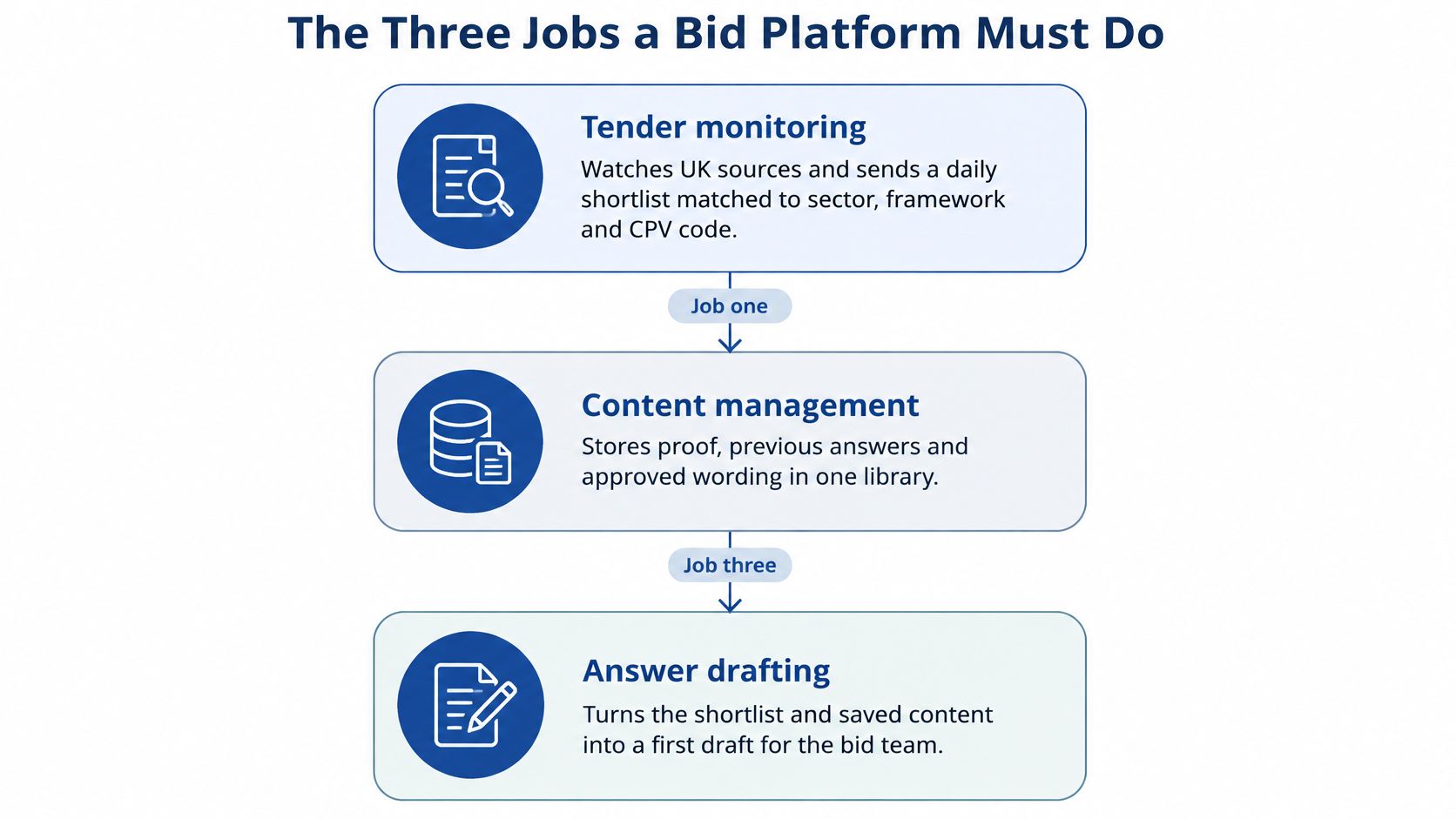
The knowledge base is where you make preparation repeatable. Load previous responses, case studies, methodologies, team biographies, policies and credentials, then identify which material is approved for reuse.
At Bidwell, our Know module provides role-based access, so commercials are visible only to people who need them. Writers should be able to retrieve delivery evidence without opening restricted margins or day rates.
Search and collaboration belong here too:
- Exact retrieval: Search should return the relevant certification scope or policy clause, not merely a document title.
- Question-level comments: Reviewers should attach feedback to the answer they mean, with the discussion retained beside it.
- Content ownership: Give someone responsibility for replacing expired or superseded evidence.
The knowledge base should be the filing cabinet you'd trust an auditor to open. Don't turn it into an unfiltered archive of everything the business has ever submitted.
Draft against the buyer's problem
In our Draft stage, you upload a blank tender or PQQ. The system extracts every question, matches it to the knowledge base and drafts answers in your voice with citations.
We draft against the actual tender notice, rather than a generic template. A methodology for maintaining occupied buildings should address the buyer's access restrictions and disruption concerns, not just repeat a standard quality paragraph.
Think of the draft as a colleague who has read the question carefully. You still check the citation, remove claims the evidence doesn't support and decide whether the proposed commitments are deliverable.
The same route supports PQQs, DDQs, security questionnaires and RFIs. The evidence may overlap, but the required answer changes with the question.
Word and Excel exports are the handover. They don't replace the decisions about what to promise, what to price and what to approve.
How UK Portal Rules Change the Shortlist
Coverage is a buying criterion, not a footnote beneath the drafting features. A UK-wide claim needs a source-by-source test.
The Find a Tender search guidance identifies 24 February 2025 as the changeover for new Procurement Act notices and explains the publication split summarised below.
Where UK public notices are published
| Service | Notices you should expect | Coverage check |
|---|---|---|
| Find a Tender | From 24 February 2025, main service for new Procurement Act notices above and below threshold, except below-threshold Scotland. Older notices usually only above threshold, often over £139,688 including VAT | Alerts include amendments tied to the same process |
| Contracts Finder | Below-threshold opportunities over £12,000 including VAT for central government, or over £30,000 outside central government, plus many awards | Lower-value work is not dropped from the filter |
| Public Contracts Scotland | Scottish public bodies, including below-threshold procurements excluded from the Find a Tender rule above | Separate Scottish source, not a copy of Find a Tender |
| Sell2Wales | Welsh public sector contracts | Welsh buyers are not assumed to appear on Contracts Finder |
| eTendersNI | Northern Ireland public sector opportunities | A UK-wide claim that skips Northern Ireland fails |
An alert isn't a decision to bid
Read the summary for lot restrictions, required accreditations and delivery geography. Then ask whether the potential work justifies the cost of preparing and assuring the response.
An apparently suitable cleaning contract may require coverage beyond your supervisor network. A framework may fit your sector but demand evidence your business can't currently supply.
Supplier selection creates a separate evidence task. The government's supplier-selection guidance distinguishes basic mandatory information held through the Supplier Information System from conditions of participation, with evidence requirements linked and proportionate to the contract.
That's why monitoring and the knowledge base need to work together. A shortlist is more useful when your bid lead can immediately establish whether the supporting financial, compliance and technical proof exists.
- Test coverage: Request yesterday's notices from at least three services, filtered to your CPV set.
- Test amendments: Check that an update is attached to its existing procurement, not presented as unrelated new work.
- Test relevance: Include an opportunity you would reject and inspect why the filter returned it.
For the underlying feed, Find a Tender's developer documentation describes structured OCDS records and procurement identifiers. Ask to see how the platform uses those identifiers to retain notice history rather than relying only on page scraping.
AI Drafts That Still Leave an Audit Trail
Faster drafting isn't the deciding advantage. Defensible drafting is. A fluent answer creates more work if nobody can establish where its claims came from.
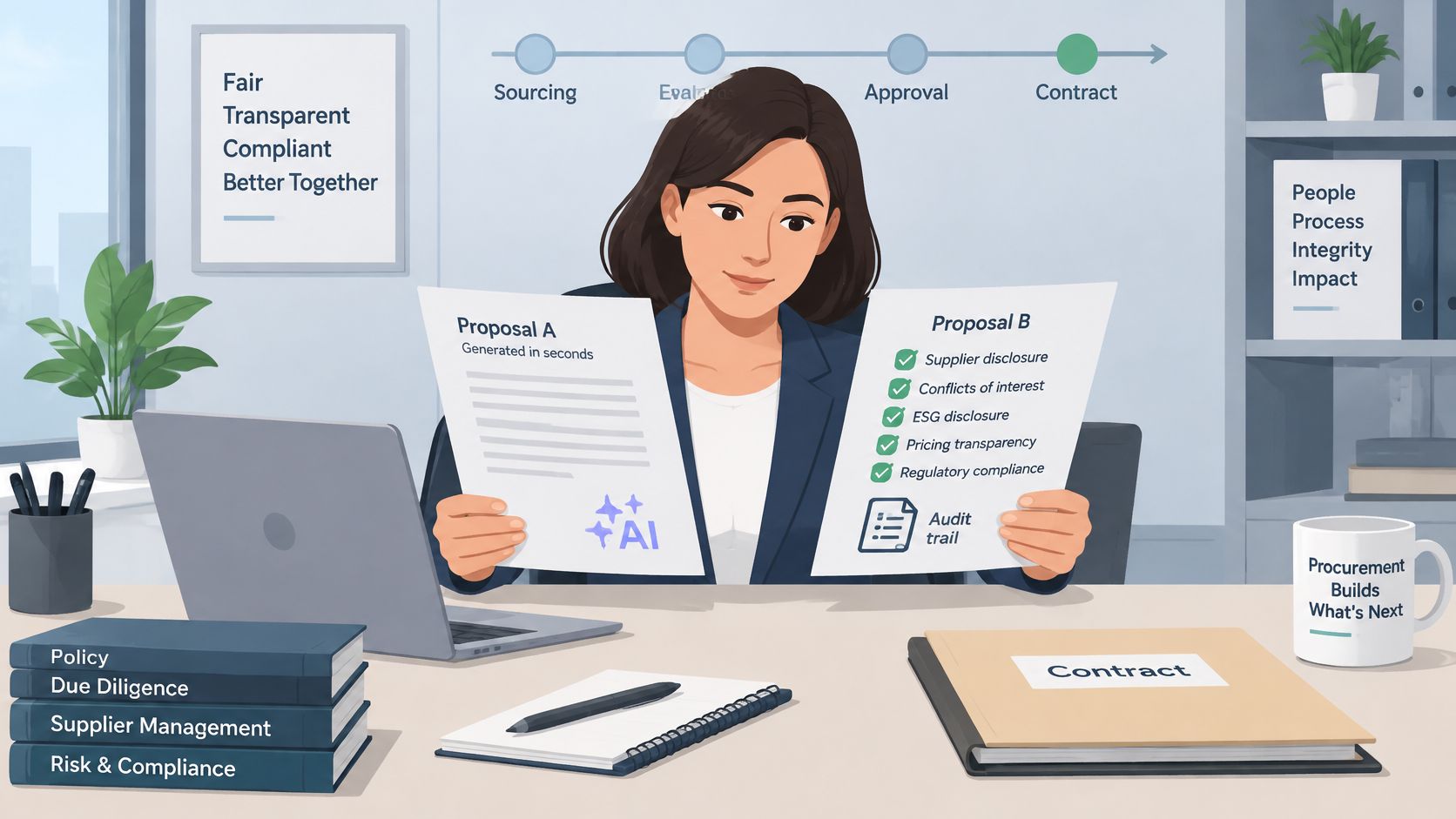
For procurements commenced on or after 24 February 2025, Procurement Policy Note 017 says contracting authorities may require disclosure of AI use in tender creation and impose controls preventing confidential procurement information from being used as training data. It also identifies possible additional due diligence where AI-generated responses raise doubts about a supplier's capacity or capability.
Keep records that explain the answer
For an SME bid team, that means an audit layer, not a chatbot beside Word. Keep the evidence close enough that a reviewer can challenge a sentence without starting another folder search.
- Source record: Retain the knowledge-base material supporting the claim, including its version.
- Unsupported text: Flag statements that require evidence or a delivery decision.
- Review history: Record who checked the answer and resolved the gaps.
- Approval record: Preserve the final approved wording and its sign-off.
- AI-use note: Document where drafting assistance was used, the source material and the human approval route.
Say a draft claims the business holds ISO 27001 certification. Without a certificate in the library, that's an unresolved claim, not submission-ready wording.
Attach the certificate, scope and expiry, then check that they cover the entity and service being offered. The wording becomes usable only when it accurately reflects that evidence.
A citation should prove the sentence beside it, not merely point to a document on the same subject.
Separate drafting assistance from responsibility
LegesGPT's AI contract drafting software is a useful adjacent comparison when considering generated contractual wording. Tender responses still need their own question-level evidence and approval process; fluent legal language doesn't establish delivery capability.
We draft the bid, but the customer reviews and approves every word. A human always signs before it goes out.
Before loading confidential material, establish how it is stored and kept out of training. Document data quality, limitations and bias risks, and complete the appropriate data-protection impact assessment before putting a live library containing personal data into use.
Prepare a short disclosure appendix where the buyer requires it. Then ask the practical buying question: can you export the citation trail with the response?
From Notice to First Draft in a Week
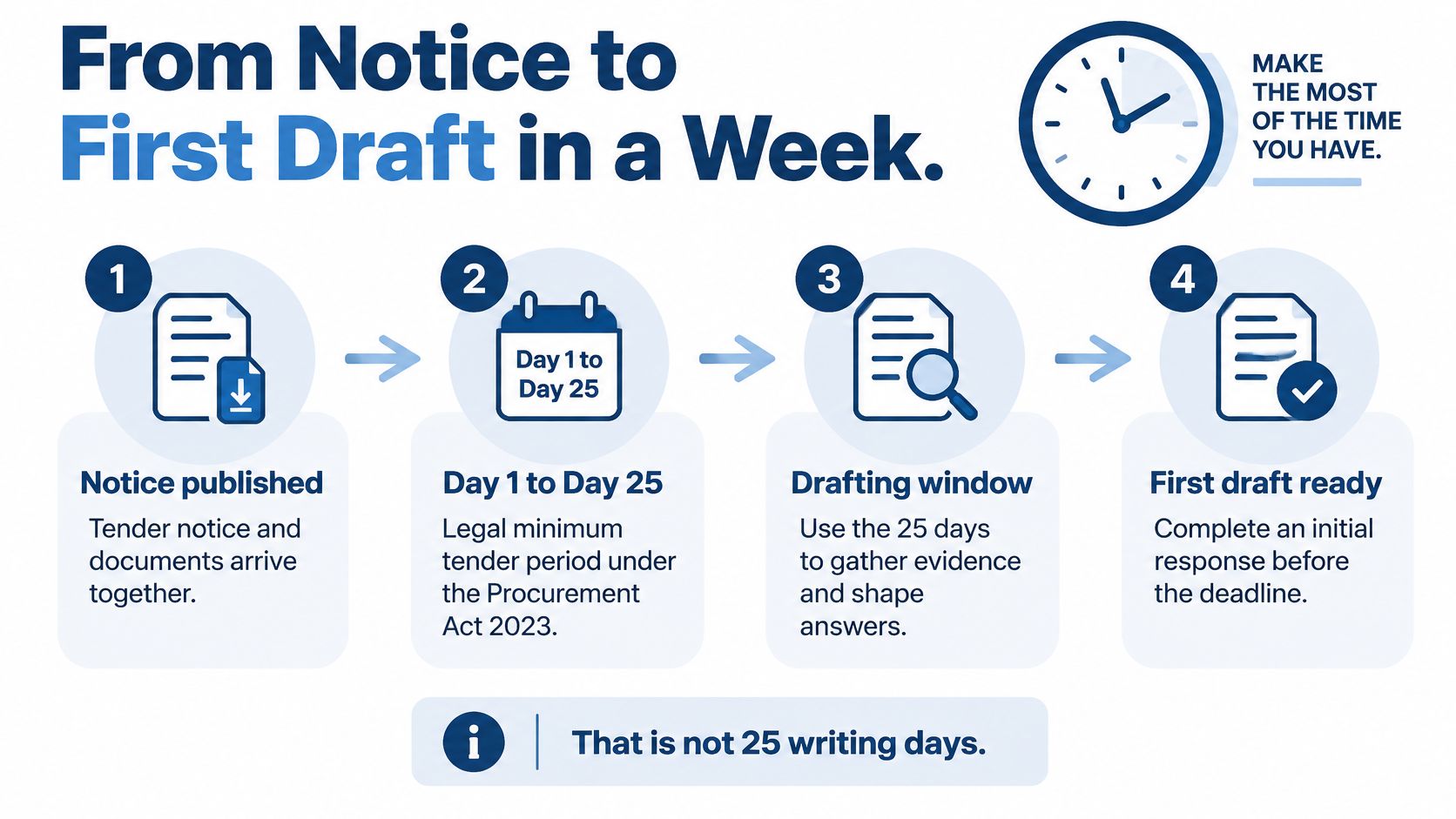
The Procurement Act's tendering-period provisions set a 25-day minimum tender period in the stated circumstances where electronic tenders are permitted and the notice and associated documents are provided together. Don't treat that as a universal deadline rule, or as uninterrupted writing time.
Clarifications, evidence gathering and internal approval all sit inside the available window. Read the actual deadline before planning the work.
A facilities supplier's planning week
Take a fictional facilities SME assessing a maintenance tender. The allocations below are hypothetical planning ranges, not promised completion times.
Day 0, assess the alert. Allow 30 to 60 minutes for bid or no-bid. Check value, lots, accreditations, location and incumbent clues before assigning a writer.
Day 0 to 1, read the pack. In this example, reserve 2 to 4 hours for a standard pack, or 4 to 6 hours for a framework. Read the specification, terms and scoring together, building a requirements list as you go.
Day 1, inspect the evidence. Allocate 1 to 2 hours to checking policies, case studies and biographies. Record missing proof and assign an owner before drafting begins.
Day 1 to 2, generate and inspect the first pass. Our first drafts return in minutes, including a first-pass response to a 60-question PQQ in 30 minutes. Reserve a further 1 to 2 hours in this scenario to reconcile extracted questions with the original pack.
Days 2 to 5, edit and approve. For this fictional bid, hold 4 to 8 hours for substantive review and director decisions. Replace generic commitments with named responsibilities, workable methods and supported evidence.
Before submission, export and validate. Set aside 1 to 2 hours in the example for checking the Word or Excel output, attachments and portal fields. Your team submits and retains the receipt.
The AI stage doesn't remove the need to read the pack. It changes where you spend your attention: less blank-page composition, more checking whether the answer meets the requirement.
Protect the review window
A missing case study can take longer to resolve than a weak paragraph. Raise that gap immediately instead of letting a plausible draft hide it.
Deadline rule: Protect review time before allocating writing time.
Keep confidential buyer documents out of model training. The operational test is whether tender monitoring gives you enough notice to do this work properly, especially when an alert arrives late.
Rolling Out Without Losing a Bid
Don't make a live deadline your first implementation test. Prepare the knowledge base while the team still has room to disagree about what belongs in it.
Prepare a controlled starting library
For a hypothetical rollout, start with the last 10 to 20 responses and three to five client-cleared case studies. Add current policies and certificates with expiry dates, then remove obsolete promises and client information you can't reuse.
Budget about a week of library clean-up as a planning allowance, not a deployment guarantee. A smaller approved collection is more useful than a large archive nobody trusts.
- Set permissions immediately: Give price-setters access to commercials and keep restricted material away from other users.
- Test another account: Use a writer's login, not the administrator's, to check what can be retrieved.
- Agree data rules: Establish storage, hosting, retention and training arrangements before uploading buyer documents.
- Assess personal data: Complete the appropriate data-protection assessment before bringing it into the live workflow.
Run a shadow submission
Choose a recent PQQ and run it through AI response generation without submitting anything. Compare the draft with the response you sent.
Count missing questions, unsupported claims and incorrect citations. Fix the source material first where the failure came from the library, rather than endlessly editing the generated paragraph.
Our workflow for bid managers keeps the focus on preparing, reviewing and approving responses. Tender monitoring should feed that process without forcing the team to abandon its current deadline controls.
Before committing, test your exit route too. Our drafts export to Word and Excel; separately confirm how you'll retrieve the library and citation history if you change systems.
Keep the existing submission process available until the shadow exercise passes. Buying software isn't a reason to gamble with an otherwise manageable bid.
Score a Tool Before the Next Deadline
Score a live demonstration using an old tender from your business. Slides won't tell you whether the product can find relevant work, retrieve the right proof and produce a reviewable response.
Buyer's checklist for request for proposal software
| Check | A pass looks like | Bidwell note |
|---|---|---|
| Tender monitoring | Daily alerts from Find a Tender, Contracts Finder, Public Contracts Scotland, Sell2Wales and eTendersNI, matched to sector, framework and CPV | Our monitoring add-on costs £10 a month, watches UK portals and summarises matches |
| Knowledge base | Past responses, credentials, policies and case studies, with commercials hidden from people who don't price | Our library is the source the draft cites, learned from existing material |
| AI response generation | Questions extracted from the blank notice and drafted to that buyer's wording, with weak claims flagged | Our first-pass answers return for human review |
| Commercial terms | You can predict the bill in a heavy bidding month | We charge no per-bid fees and no per-seat fees |
| Handover | Editors can work in familiar files and your team submits | Our drafts export to Word and Excel; your team reviews and sends |
Accept evidence, not assurances
Mark each row pass or fail. For monitoring, inspect actual coverage; for the knowledge base, test restricted access using another account.
For drafting, trace a case-study claim to its source. Accurate quotation shouldn't become an expanded promise because the generated wording sounds persuasive.
If you're comparing writing-led platforms, our Loopio alternative comparison provides another way to frame the choice. Keep your own tender and evidence as the test material.
We also offer a Tender readiness checker, Framework eligibility tool and Cost-to-respond estimator as free starting checks. Use them to establish whether your immediate problem is eligibility, preparation cost or response production.
Choose a platform when repeated public-sector bidding creates the workload and your team will review every word. Skip it if you bid once a year and a controlled shared folder already does the job.
Run a recent PQQ through the draft flow. Compare citation quality, missing requirements and review effort with the time your team recorded on that bid.
Bidwell connects tender monitoring, an approved knowledge base and AI response generation, with your team retaining final approval and submission. Visit Bidwell to test a recent PQQ and judge whether the evidence-backed drafts would make your next bid easier to review.

