You can spot the pattern quickly. A team gets a live tender alert, pulls half the company into a call, and starts writing before anyone has checked fit, evidence, or margin. The bid looks busy, but the process is already costing time you won't get back.
That's why strong bid management processes matter. They stop good teams from wasting effort on poor opportunities, and they keep better opportunities moving through a clear, repeatable system. Used properly, they're less about writing and more about control.
The Reality of UK Tender Timelines
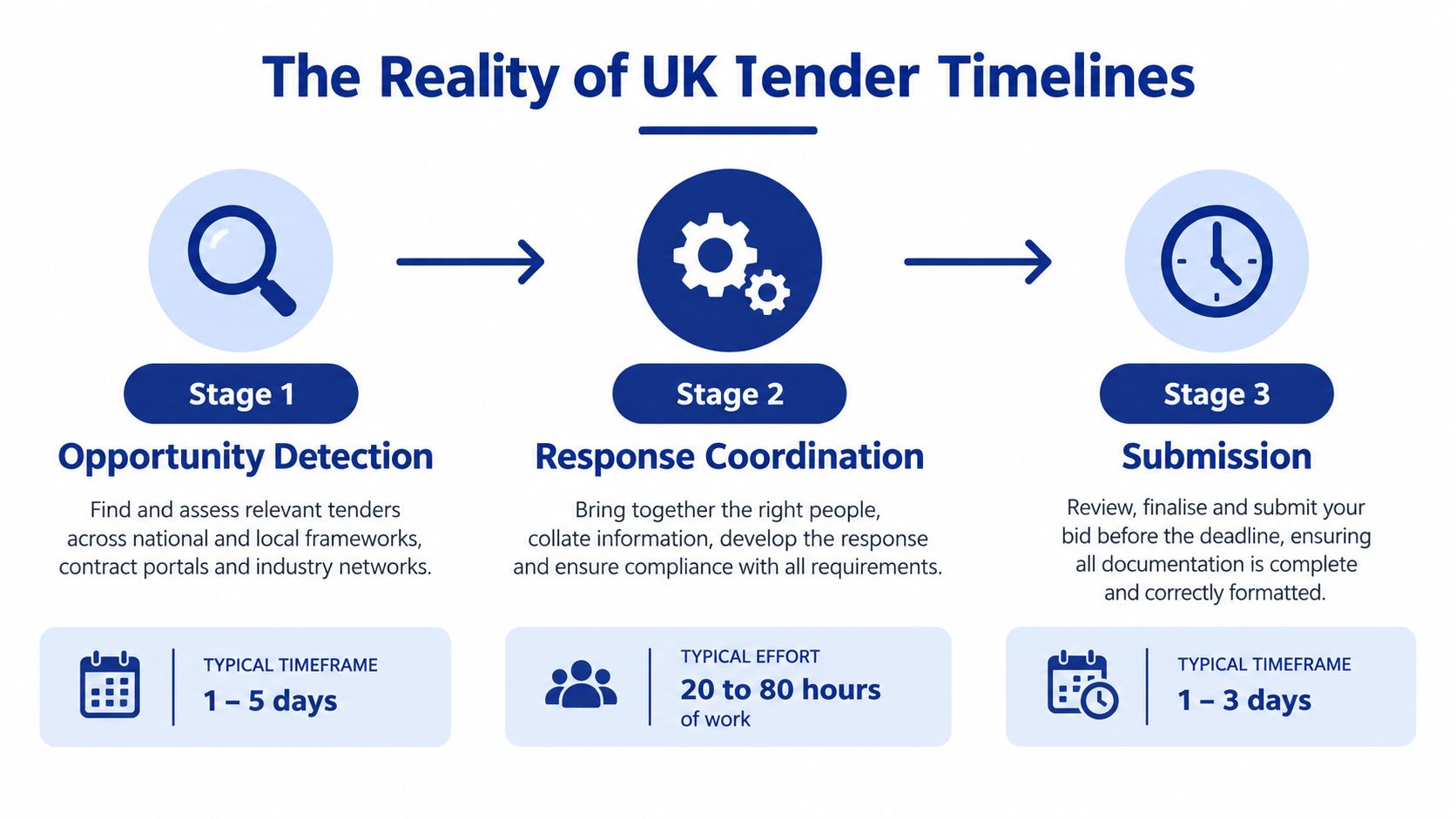
The first mistake commonly made is treating a tender like a document. It isn't. It's a short project with moving parts, a deadline, and people who need to make decisions fast.
From alert to submission
A reliable bid starts with opportunity detection, then moves into response coordination, then finishes with submission. That middle stage is where most of the work sits, because the reading, planning, writing, evidence gathering, and review cycle can easily run to a serious block of time. In practice, a digitised workflow can help a team keep ownership, version control, and approvals in one place, which is why a guide to digitised workflows is worth a look if your current process still lives in inboxes and spreadsheets.
A bid manager who understands this treats each response like a controlled project. The job is not to produce pages, it's to move cleanly from alert to decision to draft to review without losing track of requirements or attachments.
Practical rule: if no one can say who owns each section, the timeline is already slipping.
Why the clock matters
The pressure in UK tendering isn't just the deadline itself. It's the fact that every hour spent on one bid is an hour not spent on another, so a messy process has a direct opportunity cost.
That's where Bidwell's tender monitoring, knowledge base, and AI response generation fit naturally. Monitoring catches the opportunity early, the knowledge base keeps approved material in one place, and AI can draft from that material so the team spends time reviewing, not retyping. The point is not speed for its own sake, it's giving the bid team enough space to think before the submission window closes.
Qualifying Opportunities Before You Commit
A lot of SMEs lose money before they even start writing. They answer tenders because the notice looks serious, the value looks tempting, or the board wants more pipeline. That's the wrong test.
The bid or no-bid decision should be commercial first
By April 2025, approximately 75% of suppliers on Crown Commercial Service agreements were SMEs, yet SMEs accounted for just under 11% of direct spend through those agreements (UK government SME action plan). That gap matters. Being on the route to market doesn't mean you'll see meaningful revenue from it.
A good qualification gate asks harder questions than “can we bid?”. It asks whether the buyer's structure suits your business, whether the contract risk is sensible, whether the payment profile works, and whether you can mobilise without damaging delivery elsewhere. If the answer is shaky on any of those points, the bid may be technically winnable and still commercially wrong.
Here's a simple filter that works in real teams:
- Opportunity accessibility: Can a smaller supplier realistically meet the route-to-market, lot structure, and evaluation shape?
- Delivery capacity: Do you have the people, time, and subcontract support to perform?
- Cash-flow exposure: Will the payment terms and mobilisation costs create pressure before revenue lands?
- Risk balance: Are the liabilities, contract terms, or service expectations heavier than the reward?
- Strategic fit: Does this customer add value beyond a one-off contract?
If you can't explain why this bid deserves your time in one minute, you probably shouldn't pursue it.
Bid monitoring should narrow the field, not widen it
Bidwell's tender monitoring and knowledge base become useful in practice here. Monitoring helps you spot the right opportunities early, while the knowledge base lets you compare them against your actual credentials instead of your hopes. AI response generation only makes sense after that filter has done its job.
For a useful parallel outside procurement, the data-driven lead qualification guide shows the same principle in a sales context, good qualification protects time. In bidding, it protects time and margin. The teams that win most often aren't the ones that answer everything. They're the ones that know what to leave alone.
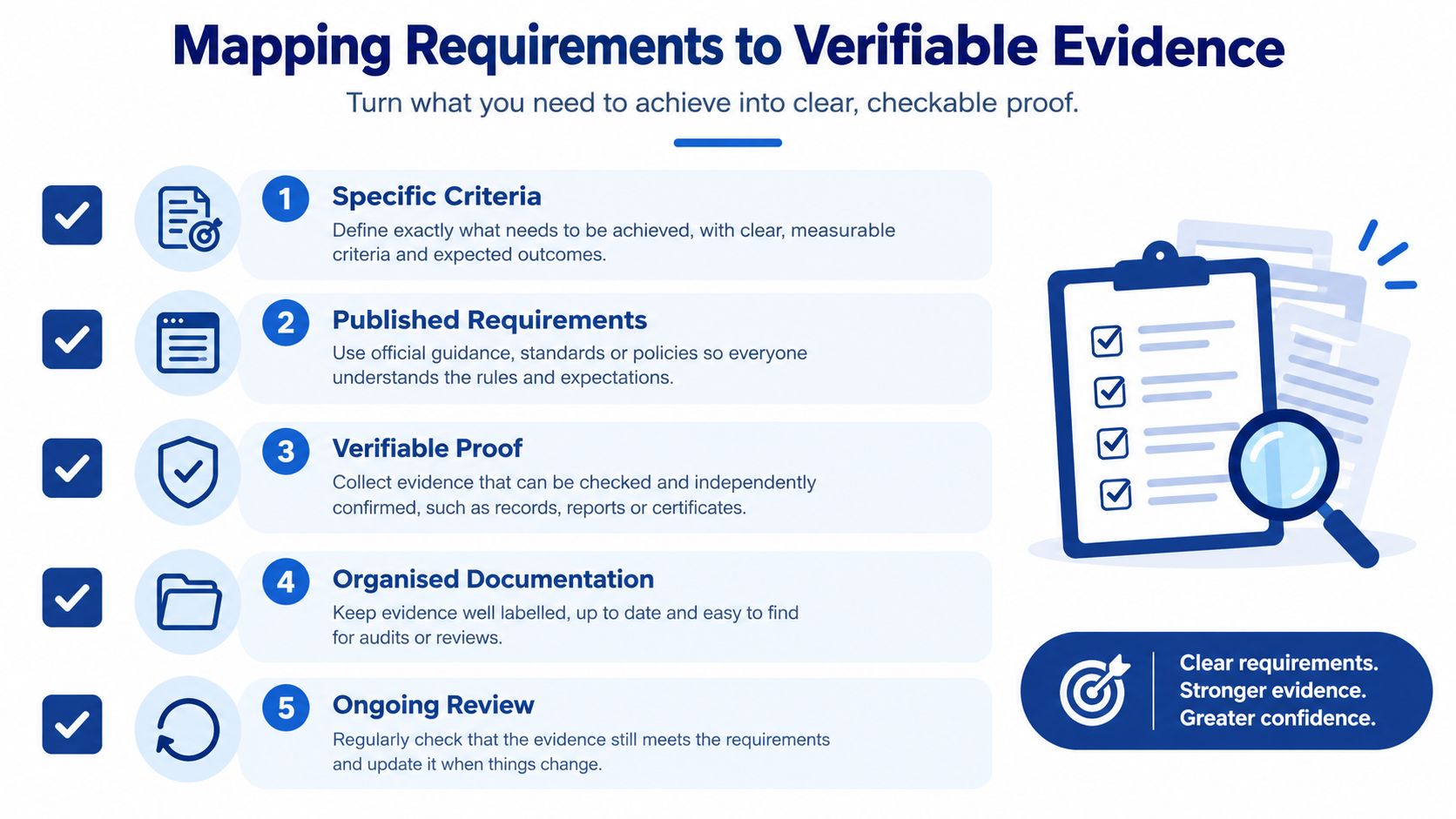
Mapping Requirements to Verifiable Evidence
Evaluators don't score your general good intentions. They score what the buyer published, in the way the buyer said they would score it. If your response wanders into generic capability language, you've already made life harder for the scoring panel.
Start with the scoring method, not the prose
Under the Procurement Act 2023, award criteria must relate to the contract subject matter, be clear, measurable and specific, and be proportionate to the procurement's nature, complexity and cost (government guidance). That means the buyer has already defined the shape of a good answer. Your job is to make it easy to score.
The simplest way to do that is with a compliance matrix. Every requirement gets a row. Each row names the answer location, the owner, the evidence source, and the review status. That sounds administrative, and it is, but it stops one of the most common bid failures, a strong answer buried in the wrong place.
A working matrix usually tracks:
- Requirement text: Copy the buyer's exact wording.
- Answer location: Show where the evaluator will find the response.
- Owner: Name the person responsible for writing or supplying the content.
- Evidence source: Link to the policy, case study, certificate, or data point behind the claim.
- Status: Flag what's drafted, reviewed, or still missing.
Mirror the buyer's structure
Good bidders don't make evaluators hunt. They use the buyer's question order, match the headings, and answer in the same sequence. That keeps the response readable and reduces the chance of missing a sub-question.
The key trade-off is simple. A prettier answer that doesn't match the scoring model loses to a plainer answer that does. So the standard is not “sounds persuasive”, it's “maps cleanly to the published criteria and evidence”. Bidwell's knowledge base helps with that, because approved policies, case studies, and credentials can be pulled into the draft without reinventing them each time.
If the buyer asks for outcomes, write outcomes. If they ask for evidence, show evidence. If they ask for method, connect the method to measurable outputs and contract-specific benefits. That discipline makes the response easier to score and easier to defend internally before it goes out.
Drafting Responses with Centralised Knowledge
Writing every bid from scratch is a waste of time and a risk to consistency. The same company overview, policies, accreditations, and case studies keep reappearing, yet many teams still rewrite them in a panic the night before submission.

Put approved material in one place
A centralised knowledge base changes the unit of work. Instead of asking, “who remembers the answer?”, you ask, “which approved version should we use?”. That cuts duplication and keeps your answers aligned with the business's current position.
Bidwell's knowledge base is built for that sort of control. It stores approved credentials, policies, past responses, and case studies, then uses AI response generation to draft from that material rather than from guesswork. Used properly, that doesn't remove the need for human review. It just means reviewers spend their time improving the draft, not creating the first version from nothing.
The same logic applies to reuse. A case study is only useful if you know when it's still valid, who owns it, and what parts can be reused safely. That's why the repository needs version control, named owners, and clear rules on what can be reused as-is.
Keep AI inside the right boundaries
Cabinet Office guidance says contracting authorities may ask suppliers to disclose AI use in tender creation and may require controls preventing confidential authority information from being used as training data (PPN 017). That's not a reason to avoid AI. It's a reason to use it carefully.
A sensible setup is straightforward:
- Approved inputs only: Feed the system from your own knowledge base, not buyer-confidential material.
- Human review at the end: Make a person check the final wording, tone, and claims.
- Source control: Keep the evidence trail visible so nothing unsupported slips in.
- Style alignment: Make sure the draft sounds like your business, not like generic software output.
If you want a practical tool for building this type of flow, Bidwell's bid writing software is one option. The value isn't magic prose, it's reducing the time spent assembling a first draft from scattered content.
Running a Two-Stage Review Process
Most tender failures aren't glamorous. They're missing attachments, inconsistent answers, late uploads, or a pricing error nobody spotted in time. That's why review has to be treated as a process, not a favour someone does on the way out the door.
Separate completeness from persuasion
The SME/VCSE Bid Pack identifies bid management as a control process with clear roles, a timetable, early collection of supporting documents, and review time before submission, and it specifically recommends at least two review rounds (government bid pack). That distinction matters.
Review 1 should check completeness. Every question gets answered, every instruction is followed, every attachment is present, and every format rule is met. If a file is missing or a mandatory field is blank, the rest of the review barely matters.
Review 2 checks quality. The evidence should be clear, credible, and tied back to the scoring criteria. The wording should be direct. The examples should support the specific claim being made, not just show that the company exists.
A tidy response can still lose if the wrong section answers the wrong question.
Don't skip commercial review
A separate commercial pass is essential. Pricing, resource assumptions, subcontractor dependencies, mobilisation costs, and margin all need to match the delivery plan. If the bid team and delivery team are not looking at the same assumptions, one of them is wrong.
That's also where internal scoring helps. Score the draft using the buyer's weighting and scale, then see where the weak spots are before you submit. A section that reads well but doesn't score well still needs work. For teams that want a structured way to run these reviews and assign owners, sops from Trupeer Inc. can help document the process so people stop relying on memory and informal handovers.
Bidwell's AI response generation fits best after these gates, not before them. Draft quickly, review twice, and only then finalise. That order reduces rework and keeps the submission grounded in evidence rather than optimism. If you manage bids at scale, Bidwell for bid managers gives a practical way to keep that workflow consistent.
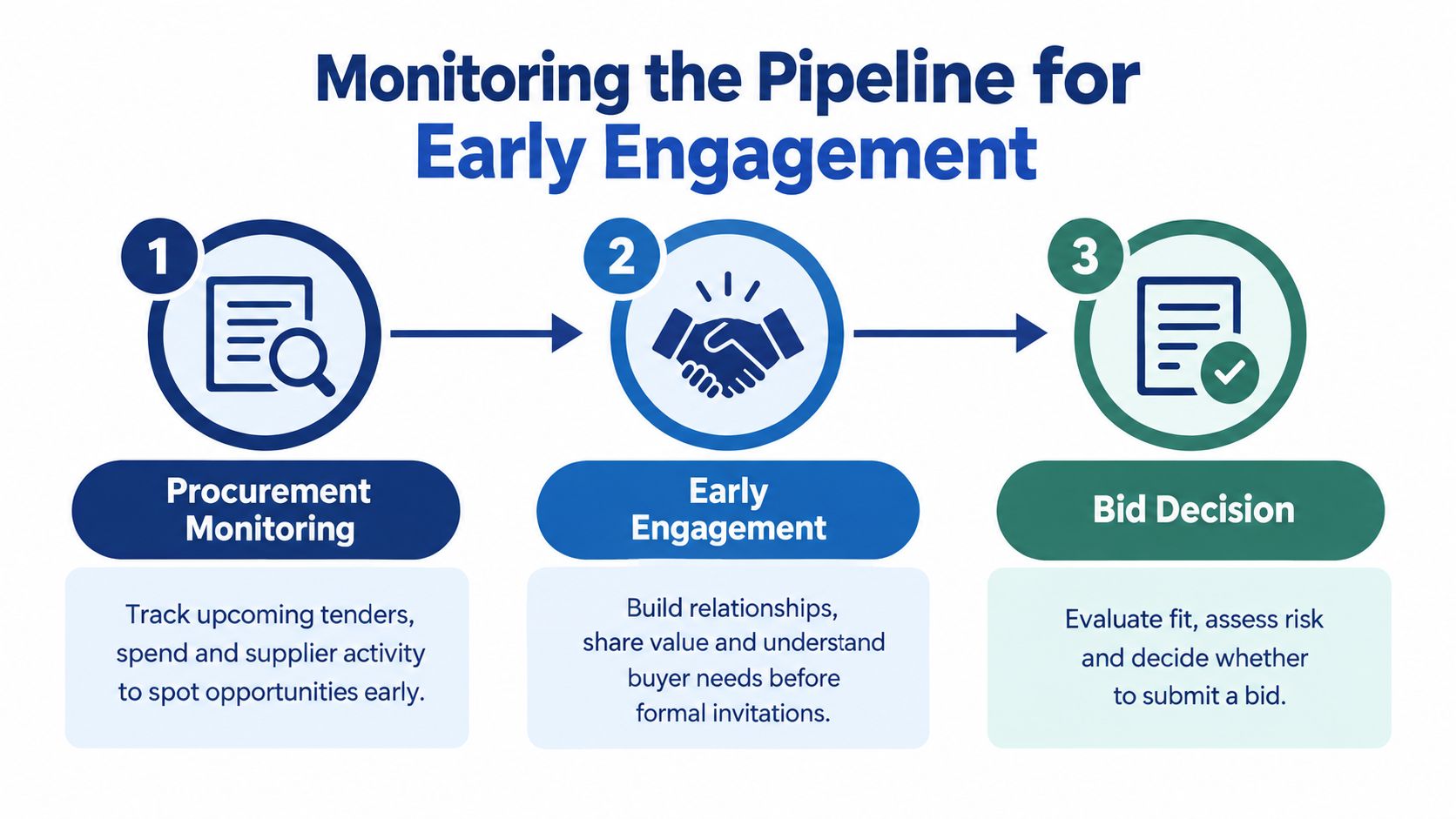
Monitoring the Pipeline for Early Engagement
A tender notice is only one signal. By the time it lands, a good bid team should already know whether the opportunity fits, who owns it, and what evidence is missing.
Track stages, not just live tenders
Find a Tender separates planning notices, tender notices and award-related notices as distinct stages (notice types). That matters because the market does not move in one jump. If you only watch active tenders, you are already late to the conversation.
Early engagement can also change the timetable. A sufficiently early preliminary market engagement notice can reduce the minimum tendering period for an above-threshold contract to 10 days, compared with the normal 25-day minimum. That gives your team less time under pressure and more room to prepare properly.
Daily monitoring helps you catch those earlier signals. AI summaries help turn long notices into something a bid manager can act on quickly. Used together, they reduce the risk of chasing work that is already poorly qualified, or missing work that needed a faster internal decision.
Build a Pipeline You Can Use
Bidwell's tender monitoring is built for that job. It watches the market, surfaces relevant notices, and uses AI summaries so your team can judge whether an opportunity deserves attention before the formal race begins. The use cases for tenders show how that monitoring sits alongside the knowledge base and response generation, rather than replacing them.
That is the practical shift. Good bid management processes start with controlled monitoring, early qualification, and enough time to build a response around the buyer's needs instead of your team's panic.